
Jiu-Jitsu is one of the most practical ways to train your body and your attention at the same time.
Most people come to Jiu-Jitsu looking for something tangible: better fitness, real self-defense skills, a healthier routine, maybe a confidence boost that actually sticks. What surprises many new students is how quickly training starts to change the way you think and move outside the mats, too. When you practice consistently, you are not just learning techniques. You are building mindful strength, the kind you can feel in your posture, your breathing, and your decision-making.
In our San Jose, CA classes, we treat focus as a trainable skill. The mat gives you immediate feedback: if your attention drifts, you lose position; if you rush, you gas out; if you tense up, you get stuck. That is not a flaw in the training, it is the point. Over time, you learn how to stay present under pressure, and that carries into everyday life in a very practical way.
What mindful strength actually means on the mat
Mindful strength is not just being strong. It is being able to apply strength at the right moment, with the right intensity, without wasting energy. In Jiu-Jitsu, raw effort rarely beats timing and structure for long. So we coach you to develop alignment, leverage, and controlled breathing that supports your movement instead of fighting it.
This is where mindfulness becomes real, not abstract. You notice what your shoulders are doing, whether your jaw is clenched, whether you are holding your breath. You start to recognize patterns, like the moment you tend to panic in a bad position or the moment you rush a sweep that is not there yet. And because you get to try again in the next round, you improve fast.
Mindful strength also shows up in how you train with partners. Learning to be assertive without being reckless is a skill. We want you to train hard, but we also want you to train intelligently, with control and respect. That balance is part of what makes the practice sustainable.
Why Jiu-Jitsu builds focus better than most workouts
Many workouts are repetitive by design. That is not a bad thing, but it can allow your mind to drift. Jiu-Jitsu asks you to solve problems in real time. Positions change, grips break, angles shift, and you have to make decisions quickly, then adjust when your partner counters. That constant decision-making keeps you mentally engaged.
Focus in training is not about being intense all the time. It is about being aware. We coach you to notice what is happening, pick one simple goal, and execute. A small example: instead of trying to do ten things at once from bottom position, you might focus on framing correctly, recovering guard, and breathing smoothly. When you narrow the target, your body follows.
A nice side effect is that your attention gets cleaner. Many students tell us they feel less scattered after class, like the mental noise quiets down. That makes sense. For an hour, you are fully in the present moment because you have to be.
Breathing and posture: the quiet foundation of everyday calm
If you want more everyday focus, start with two basics: breathing and posture. You cannot separate them for long. When your posture collapses, your breathing gets shallow. When your breathing is shallow, your nervous system stays keyed up. Jiu-Jitsu gives you a practical reason to work on both, because poor posture and poor breathing get exposed immediately.
We cue breathing in a very down-to-earth way. We want you to exhale during effort, inhale when you create space, and avoid breath-holding when you feel pressure. That habit transfers to regular life. You end up handling stressful moments with less tension because you have practiced staying functional while someone is literally trying to control you.
Posture shows up everywhere on the mat: in base, in frames, in how you carry your hips, and in how you use your spine to create pressure or escape it. Over time, you begin to stand differently. Not stiff, just organized. People notice that kind of confidence.
The focus loop: how training turns stress into a skill
A big reason Jiu-Jitsu builds everyday focus is that it teaches you how to cycle through stress without getting stuck in it. You experience pressure, you respond, you recover, and you reset. That loop is incredibly relevant to modern life, where stress is not a single event but a constant drip of tasks, notifications, and obligations.
On the mat, you learn to separate urgency from panic. You might be in a tough position, but you can still find small wins: protect your neck, build a frame, create an angle, re-guard. That step-by-step thinking is exactly what you need in a busy workday or a complicated family schedule. You stop catastrophizing and start solving.
We also build the habit of reflection without overthinking. After a round, you can ask one or two questions: What worked? What failed? What will I try next time? That simple process improves performance without beating you up mentally.
What a typical class feels like when you are building mindful strength
Our classes are structured to keep you progressing while staying safe and supported. You will usually move through a warmup that prepares your joints and movement patterns, technique instruction with clear details, and drilling that gives you enough repetitions to actually learn the skill. Depending on the class, you may also have controlled sparring where you apply what you learned with real resistance.
The experience is challenging, but it is not chaotic. We want you to feel like you are building something, not just surviving. That matters for mindfulness because you improve faster when you can stay curious. If every round feels like panic, your attention narrows too much. If every round feels too easy, you do not adapt. The sweet spot is effort with a clear purpose.
You will also notice the culture on the mat. Training partners matter. When people are respectful and consistent, it becomes easier to focus, because you are not bracing for unpredictability. You can just train.
Practical ways to use Jiu-Jitsu for everyday focus outside the academy
The point of training is not to leave everything on the mat. We want you to take the lessons with you. Here are a few simple ways we encourage students to bridge training to daily life without getting overly complicated:
• Pick one focus theme per week, like breathing under pressure, staying relaxed in transitions, or committing to a clean first grip.
• After class, write down one thing you did well and one thing you will practice next time, keeping it short enough that you will actually do it.
• Use the same reset you use between rounds in real life: exhale, drop your shoulders, and choose the next right action.
• Notice tension patterns, especially jaw clenching and shoulder hiking, and treat them like cues to breathe and re-center.
• Keep your goals process-based, such as training twice a week consistently, rather than outcome-based, such as needing to be perfect quickly.
These are small habits, but they are sticky because you practice them repeatedly in a physical environment. That makes them easier to access when you need them.
Youth training and attention: building focus early in a healthy way
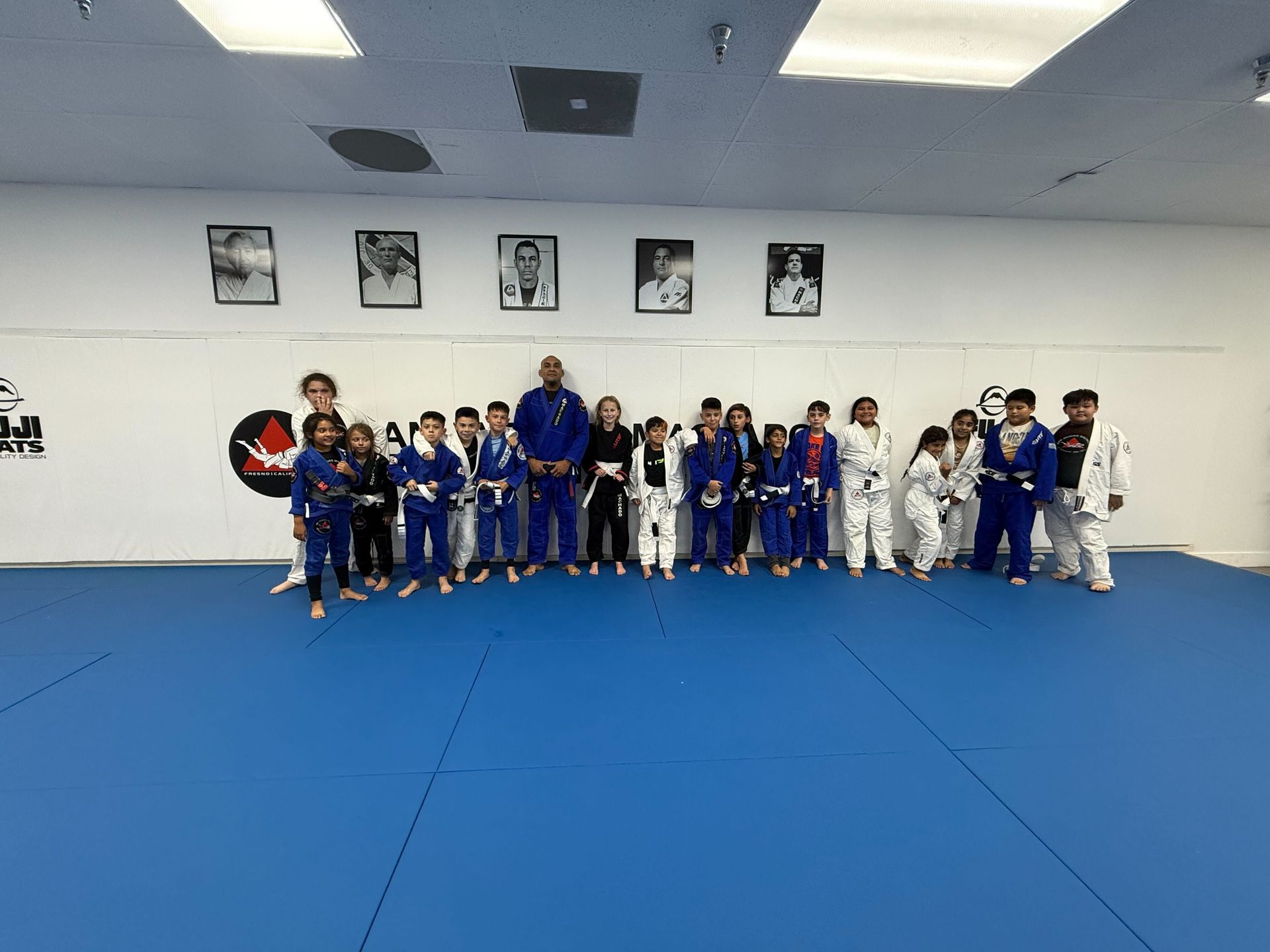
For families looking at Youth Jiu-Jitsu San Jose, CA options, focus is often a top priority. We understand that. Kids and teens are dealing with busy school days, social pressure, and a lot of screen-driven distraction. Training gives young students a space where attention is not optional, but it is also not punished. It is coached.
Youth classes can help students learn body awareness, balance, and coordination while also practicing listening skills and emotional regulation. When a young student gets frustrated, we teach constructive ways to reset and try again. That is a life skill. When a young student is doing great, we teach humility and control. That is also a life skill.
Parents often appreciate that Jiu-Jitsu provides a clear structure: line up, warm up, learn, drill, and apply. That predictability helps many kids settle in and focus. And because progress is measurable, young students can feel pride in improvement that comes from effort, not shortcuts.
How we structure progress so focus stays consistent
One of the easiest ways to lose focus is to feel lost. So we make sure the learning path is progressive. We teach fundamental movements and concepts, then build toward more complex scenarios. You do not need to be in peak shape to start, and you do not need any prior experience. You just need a willingness to practice.
Here is the progression we aim for in a way that stays realistic for busy adults and families:
1. Learn foundational positions and safety habits so you can train with confidence and control.
2. Build a small set of reliable escapes and guard recoveries so you feel less stuck under pressure.
3. Add high-percentage controls and submissions with an emphasis on timing, posture, and leverage.
4. Improve transitions and decision-making so you can link techniques instead of doing isolated moves.
5. Refine your personal style so training supports your body type, your goals, and your schedule.
That structure matters for mindfulness because it reduces mental clutter. When you know what you are working on, you can focus deeply instead of chasing everything at once.
Training in San Jose: making the practice fit real life
We serve students across Jiu-Jitsu San Jose, CA needs, which means we see every kind of schedule. Some people train early, others come after work, and many parents are balancing family logistics. Our goal is to make training accessible, not overwhelming.
Consistency is where mindful strength is built. Two focused sessions per week usually beat one intense session followed by a long break. When you train consistently, you start to feel the benefits in your energy levels, your posture, and your patience. You also start to notice something subtle: everyday tasks feel simpler because you are more practiced at prioritizing and staying present.
If you are returning after time off, we meet you where you are. If you are new and nervous, that is normal. You will not be the only beginner in the room, and you will not be expected to know what you are doing on day one. The job is to show up, learn a little, and repeat.
Take the Next Step
If you want a training practice that strengthens your body while sharpening your attention, we have built our classes to deliver exactly that, one focused rep at a time. The mat is where you learn to breathe, problem-solve, and stay steady under pressure, and those skills tend to show up later when you are driving in traffic, presenting at work, or simply trying to be more patient at home.
We would love to help you experience that process firsthand at Gracie Jiu-Jitsu San Jose, whether you are starting fresh, getting back into training, or looking specifically for Youth Jiu-Jitsu San Jose, CA programs that build confidence and focus in a healthy, structured way.
Turn what you learned here into hands-on training by joining a Jiu-Jitsu class at Gracie Jiu-Jitsu San Jose.