
A smart, structured training week can change how you think, move, and handle pressure, even outside the mats.
If you live and work in San Jose, your brain probably does a lot of heavy lifting before your body gets much of a say. Long sits, tight hips, a crowded calendar, and that constant background hum of deadlines can add up faster than most people realize. That is exactly why we teach Jiu-Jitsu as more than “just a workout.” Done the right way, it becomes a practical reset for your focus, your flexibility, and your stress level.
San Jose is also a legit hub for Brazilian Jiu-Jitsu competition. In 2024, the IBJJF San Jose Spring event alone awarded 484 medals to 381 fighters across 208 divisions. That kind of turnout tells you something important: there are a lot of people training consistently here, and the local skill level is high. Our job is to help you benefit from that energy without needing to live like a full-time competitor.
In this guide, we will break down how our training is designed for real adults with real schedules, how Jiu-Jitsu supports daily focus, flexibility, and stress relief, and how we keep progress steady and safe.
Why San Jose Keeps Showing Up for Jiu-Jitsu
San Jose does not “kind of” train. The numbers from major events make that obvious: hundreds of competitors, hundreds of divisions, and medal counts that look more like a festival scoreboard than a small tournament. The gi and no-gi events in 2024 also showed strong participation, including 183 medals awarded to 125 fighters across 93 divisions in a San Jose no-gi championship.
We pay attention to this for one reason: it reflects the local culture of consistency. People here commit to skill-building. And Jiu-Jitsu rewards that kind of mindset, because improvement is rarely sudden. It is layered, earned, and measurable in a way that feels satisfying.
A recent survey of nearly 2,000 practitioners also reinforces the longer arc of progression. Average time at white belt was about 2.3 years, and reaching purple belt averaged about 5.6 years, with brown belt around 9 years. If you are new, that timeline might sound long. In practice, it is actually reassuring. It means we can focus on skill, safety, and real understanding, not rushing for the next belt.
Daily Focus: How Training Builds a Calmer, Sharper Mind
Jiu-Jitsu makes focus unavoidable, in a good way. When you are learning a technique, you cannot half-listen and still do it correctly. When you are sparring, you cannot scroll your mental to-do list and expect to keep your posture, frames, and breathing. Attention becomes the skill underneath every other skill.
The “micro-decision” effect (and why it carries into your day)
One of the sneaky benefits of Jiu-Jitsu is how often you practice choosing the next right action under pressure. You are constantly answering small questions:
• Where are my elbows?
• What is my opponent’s base doing?
• Can I improve position before I chase a submission?
• Do I need to slow down and breathe, or commit and move?
That repetition trains a kind of grounded decision-making. Many students tell us they notice it at work: fewer frantic reactions, more deliberate choices, and an easier time returning to the task in front of them.
Drilling for focus, sparring for focus
In our classes, drilling is where focus becomes clean and technical. You get to repeat a movement enough times that details start to matter, like hip angle, grip placement, and timing. Sparring adds intensity and unpredictability, but it also teaches you to stay present when your heart rate goes up. That is a skill you can use anywhere in San Jose traffic, in a meeting, or on a day that feels like it has too many tabs open.
Flexibility and Mobility: Jiu-Jitsu for Desk-Bound Bodies
Most adults do not need “more stretching” as vague advice. You need a reason to move your hips and shoulders through useful ranges of motion, consistently, without it feeling like punishment. Jiu-Jitsu gives you that reason.
Guard work alone asks a lot from your hips, hamstrings, and lower back, but it does it in context. Instead of touching your toes and calling it a day, you are learning to move your legs, frame with your shins, rotate your hips, and recover position.
Where flexibility actually shows up on the mat
Mobility is not just about being bendy. In Jiu-Jitsu, it shows up as options. If your hips can move, you can re-guard. If your shoulders can rotate safely, you can frame and pummel without feeling stuck. If your ankles and knees tolerate angles well, you can build a base and stand up with control.
We also coach you to build flexibility without being reckless. Progress should feel like “I can move better this month than last month,” not “I tweaked something again.”
A simple training rhythm that supports flexibility
Consistency beats intensity here. Training two to three times per week, paired with a short mobility routine at home, tends to produce the best results for busy adults. We would rather you train sustainably than go hard for two weeks and disappear for two months.
Stress Relief: The Healthy Kind of Tired
San Jose stress can be weirdly quiet. You can feel fine, technically, and still notice you are clenching your jaw at your laptop. Jiu-Jitsu gives you a physical outlet that also requires mental engagement, which is a powerful combination. After class, your mind is often calmer because it finally had one job: solve the problem right in front of you.
Rolling is also a pressure valve. It is challenging, but it is controlled, and it is social in a way that does not require small talk if you are not in the mood. You show up, train, and leave feeling lighter.
Stress relief without “checking out”
Some workouts let your brain drift. Jiu-Jitsu is different. You get relief because you have to stay present. That presence interrupts the loop of rumination that fuels a lot of stress in the first place.
Safety, Injury Risk, and How We Train Smart
Any contact sport has risk. A 2019 study that is still widely referenced found that 59.2 percent of athletes experienced at least one injury in the prior six months, with higher risk tied to more classes per week. We take that seriously, especially for adults balancing training with work and family.
Our approach is simple: technical progress and safety are connected. When you learn to frame correctly, tap early, control your pace, and avoid muscling positions, you reduce injury risk while improving faster.
What we emphasize to keep training sustainable
Here are a few principles we coach from day one:
• Tap early and tap often while you learn, because “toughing it out” is not a skill
• Choose control over speed, especially in scrambles where joints get stressed
• Build positions before submissions so you are not yanking on anything
• Communicate with training partners about intensity, injuries, and experience level
• Treat recovery as part of training, not a bonus you earn later
We also scale training so you can keep showing up. The goal is not to survive class. The goal is to improve, week after week.
What You Learn in Adult Jiu-Jitsu in San Jose, CA
When people search Adult Jiu-Jitsu San Jose, CA, the real question underneath is usually: “Will I be totally lost?” Our answer is no, not if the program is structured.
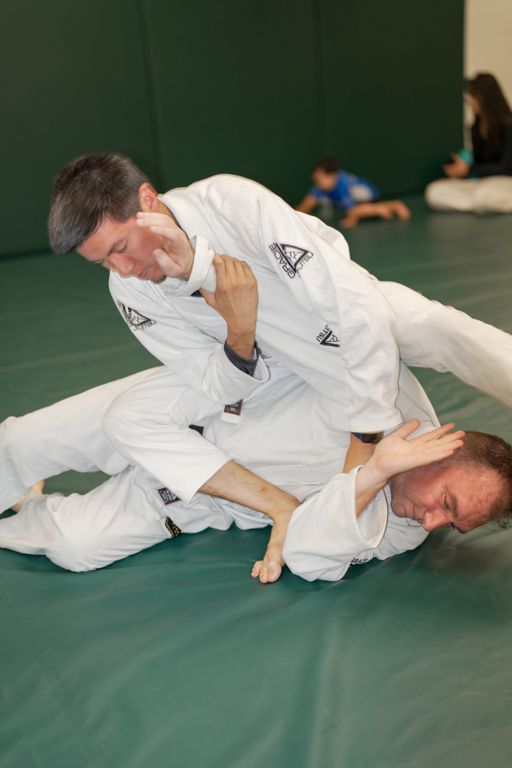
We teach fundamentals in a way that gives you immediate tools while building long-term skill. That includes positional escapes, guard retention concepts, top control, and submissions that are taught with safety and mechanics first.
A typical class experience (what it feels like)
Most classes include a warm-up focused on movement patterns you will actually use, technique instruction with drilling, and then controlled sparring. The vibe is focused, but not stiff. You will work hard, but you will also have clear goals for the day, which helps a lot if your mind is usually racing.
And yes, you can start without being in great shape. Training is how you get in shape for training. It is a loop, and it starts wherever you are.
Gi vs No-Gi: Which Should You Start With?
Both are valuable, and both can support your goals. The gi slows the game down a bit and makes grips and posture more obvious, which can help beginners understand leverage. No-gi tends to be faster and requires strong positional awareness because there is less fabric to hold.
We recommend starting with whatever fits your schedule and comfort level, then expanding once you have momentum. The important part is consistency, not “the perfect choice.”
Progress, Belts, and Staying Motivated Without Rushing
Belts matter, but they are not the best day-to-day metric. In Jiu-Jitsu, progress is often felt as small wins:
• You escape a position you used to get stuck in
• You breathe instead of panicking under pressure
• You recognize a setup before it happens
• You control the pace of a round without gassing out
The survey data on belt timelines is helpful because it normalizes the process. If it takes time, that is not a problem. That is the art working the way it is supposed to.
How to Start (and Keep It Simple)
Getting started with Jiu-Jitsu San Jose, CA should feel straightforward. We keep the first steps clear so you can focus on showing up and learning.
1. Check the class schedule and pick a beginner-friendly time you can repeat weekly
2. Arrive a little early so we can help you get oriented and answer questions
3. Start with fundamentals and focus on posture, frames, and breathing
4. Add intensity gradually as your timing and comfort improve
5. Track consistency, not perfection, because that is where results come from
If your goal is daily focus, flexibility, and stress relief, this structure matters. When training is organized, your mind can relax into the work.
Take the Next Step
Building a sharper mind, a more mobile body, and a healthier relationship with stress is exactly what we aim for, and we do it through practical Jiu-Jitsu that fits real life in San Jose. When you train with us, you are not signing up for chaos or ego. You are stepping into a process that values safety, steady progress, and skills you can actually use.
At Gracie Jiu-Jitsu San Jose, we keep the path clear: show up, learn fundamentals, train with intention, and let the benefits compound over time. If you are ready to feel more focused during your workday, looser in your hips and shoulders, and calmer after a tough week, we would love to help you start.
Improve your fitness, confidence, and grappling ability by joining a Jiu-Jitsu class at Gracie Jiu-Jitsu San Jose.