
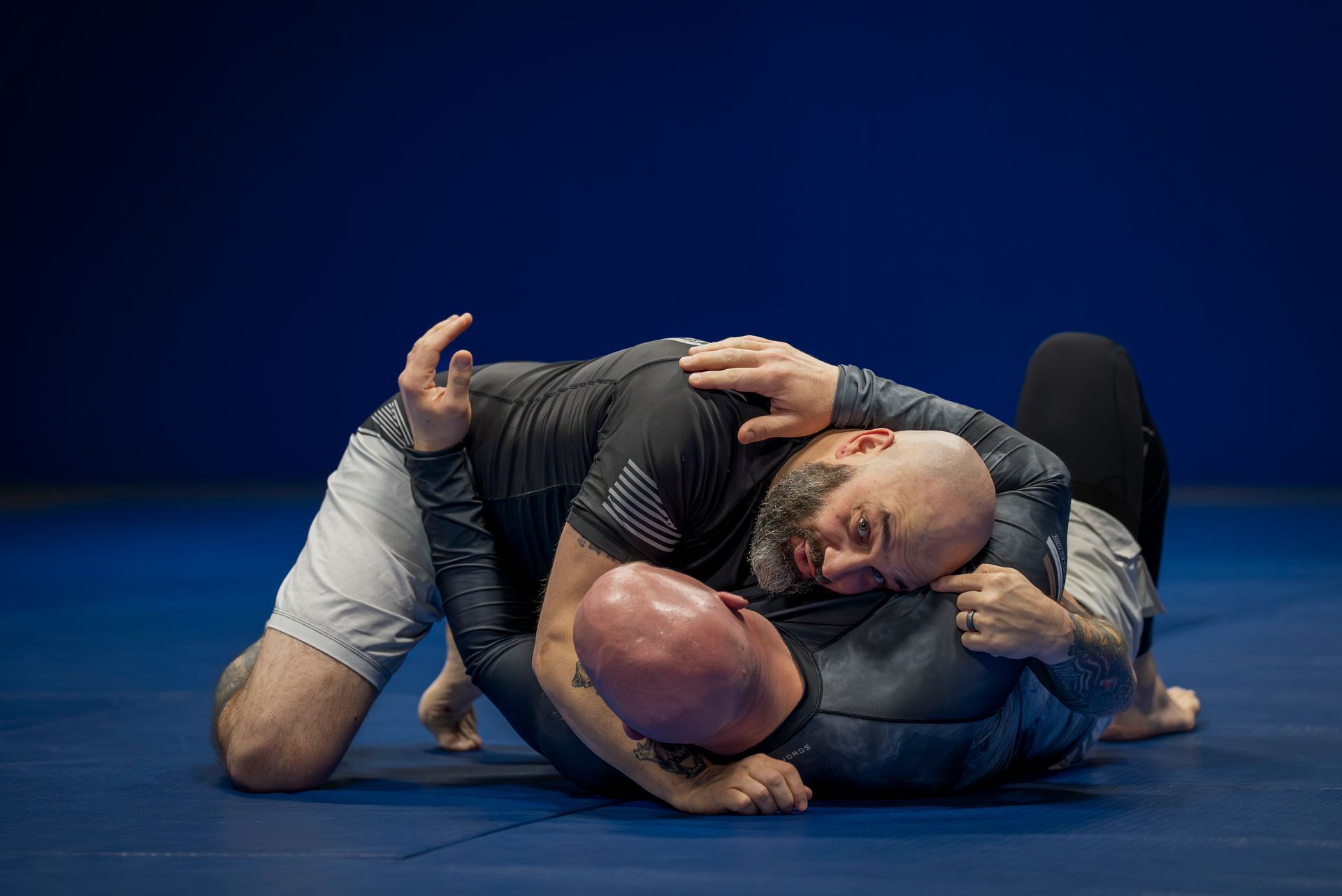
Jiu-Jitsu has a way of turning everyday stress into a trainable skill, one round at a time.
Life in Canton can feel beautifully full and also a little relentless: work deadlines, school schedules, family logistics, and the constant pressure to keep up. When people ask us what training really does for you beyond fitness, we usually come back to the same answer: Jiu-Jitsu builds mental toughness in a practical, repeatable way, because the mat gives you real problems to solve under pressure.
That is why so many students stick with it once they start. You learn how to stay calm when you are uncomfortable, how to make decisions when you are tired, and how to keep showing up even when you are not instantly “good” at something. Those skills matter in the real world, whether you are a parent trying to stay patient, a professional leading a team, or a kid learning how to handle big feelings without melting down.
In this guide, we will break down the specific training strategies we use to develop resilience in our academy in Canton, Connecticut, including how our kids and adult programs approach mindset, structure, and steady progress.
Why Jiu-Jitsu Builds Resilience Faster Than Most People Expect
Jiu-Jitsu is not just hard. It is honest. The feedback loop is immediate: your posture, breathing, timing, and focus either hold up or they do not, and you get a chance to adjust right away. That kind of environment teaches resilience because it makes challenges normal, not scary.
One of the biggest mindset shifts happens early. Instead of seeing discomfort as a sign to stop, you learn to treat it like information. Maybe your grips are wrong, maybe you are holding your breath, maybe you are trying to force a move that is not there. The mat turns frustration into data, and that is a powerful mental upgrade.
Resilience also comes from training in small, manageable doses. We do not throw you into chaos without a path. We build from fundamentals to live resistance in a way that helps you feel the difference between panic and pressure. Over time, you realize you can handle more than you thought, and you carry that certainty into the rest of your week.
The Core Mental Skills We Train (Even When We Do Not Call Them “Mental Skills”)
Composure: Staying Present When Your Heart Rate Spikes
Composure is not “being calm.” It is staying functional when you are not calm. In training, your body reacts: you feel pinned, you feel stuck, you feel rushed. We coach you to come back to posture, frames, and breathing, because those are anchors you can control.
A simple example is learning to pause for half a second before you explode into motion. That small pause often changes everything. It keeps you from burning energy, making sloppy decisions, or mentally quitting in the middle of a bad position.
Adaptability: Letting Go of Plan A Without Spiraling
A lot of people show up with an expectation that there is one correct answer. In reality, Jiu-Jitsu rewards adaptability. A sweep fails, so you switch to a guard recovery. A submission is defended, so you transition to position. You learn to stay solution-focused even when the first idea does not work.
That translates directly to real life. When you stop treating setbacks like personal failures, you free up energy to problem-solve. This is one of the quiet benefits of consistent training: you become harder to rattle.
Discipline: Doing the Work When Motivation Is Not There
We all like the idea of motivation. But motivation is inconsistent. Discipline is what shows up on the days you would rather go home and sit down for “just a minute” that turns into the whole evening.
Training builds discipline through routine. You commit to classes, you warm up, you drill, you spar, you cool down. The structure does something to your mind. It tells you: you can be tired and still do the next right thing.
Strategy 1: Use Breath and Posture as Your Reset Button
When pressure hits, your breathing often becomes shallow, and your posture collapses. In Jiu-Jitsu, that leads to quick fatigue and rushed decisions. So we teach a practical reset: fix your posture, then fix your breath, then choose your next action.
This is not theory. You feel it immediately when you stop holding your breath and start “breathing on purpose.” You become harder to break, and your mind stops racing. Even a simple inhale through the nose and long exhale can turn a bad moment into a workable moment.
Off the mat, the same reset helps during difficult conversations, stressful meetings, or even when you are stuck in traffic on Route 44 and you can feel yourself getting irritated. Posture and breath are portable tools. You always have them.
Strategy 2: Train the “Uncomfortable, Not Unsafe” Zone
A big part of resilience is learning the difference between discomfort and danger. Jiu-Jitsu gives you a controlled setting to explore that. You learn to be uncomfortable while still being safe, and that changes your relationship with stress.
We build that skill progressively. Early on, you practice positions with clear objectives and boundaries. As you improve, you add live resistance and rounds that require you to think while tired. The point is not to overwhelm you. The point is to expand your capacity a little at a time.
This matters for both kids and adults. Kids learn they can handle frustration without a meltdown. Adults learn they can stay composed without needing everything to be perfect first.
Strategy 3: Turn “Losing” Into Learning With Simple After-Round Questions
If you have ever sparred, you know the feeling: you try something, it fails, and your brain wants to label it as a loss. We coach you to reframe that moment with a few practical questions that keep your mindset productive.
After a round, we might ask:
- What position did you get stuck in most often?
- Did you breathe, or did you hold your breath?
- What was the first grip or frame that broke down?
- What is one adjustment you can try next round?
That is resilience in action. You do not deny the difficulty. You engage with it. You walk away with a plan.
This also reduces the emotional swing that can come with training. Some days you feel great. Some days you feel like you forgot everything. The questions keep you steady, because progress becomes measurable and specific.
Strategy 4: Build Confidence Through Micro-Wins, Not Big Speeches
Confidence is not something we talk you into. It is something you earn through small, repeatable wins. In Jiu-Jitsu, micro-wins are everywhere: recovering guard, escaping side control, keeping posture in someone’s closed guard, finishing a clean technical stand-up.
Those wins add up. They teach your nervous system, “I can solve problems under pressure.” That is the kind of confidence that holds up when life gets messy, because it is built on evidence, not hype.
We also like micro-goals because they work for every personality type. If you are competitive, micro-goals keep you grounded. If you are cautious, micro-goals keep you moving forward without feeling overwhelmed.
Strategy 5: Use Consistent Routines to Reduce Mental Load
A surprising part of resilience is reducing decision fatigue. When you have a consistent training routine, you remove a bunch of mental noise. You know where you are going, what you are working on, and what “done” looks like for the day.
Our class structure supports that. You warm up, you drill a focused technique set, you practice with resistance, and you finish with live rounds when appropriate. That rhythm helps you settle in and learn faster, because your mind is not constantly asking, “What is happening next?”
For many students, this becomes a weekly anchor. You leave class physically tired, sure, but mentally lighter. The day’s stress feels less sticky.
What Mental Toughness Looks Like in Our Kids Program
Parents often tell us they want their child to be more confident, more focused, or less reactive when things do not go their way. Those are big goals, and we approach them through small habits: listening skills, respectful behavior, and consistent effort.
In our kids Jiu-Jitsu in Canton CT program, resilience shows up in moments that look ordinary but are actually huge:
- A child loses a position and tries again instead of shutting down
- A child takes coaching and applies it without getting embarrassed
- A child learns to pause, breathe, and use technique instead of flailing
- A child practices being a good partner, even when competitive feelings show up
We keep training age-appropriate and structured, because kids learn best when expectations are clear and the environment is supportive. Over time, those habits tend to spill into school, sports, and home life in a way parents can actually see.
What Mental Toughness Looks Like in Our Adult Program
Adults come in for different reasons: fitness, stress relief, self-defense, community, or just needing a challenge that feels real. Whatever brings you in, our adult Jiu-Jitsu in Canton CT classes are designed to build both skill and steadiness.
You will learn how to manage intensity without ego driving the car. That is important. If you go too hard too soon, you get injured or burned out. If you never push at all, you plateau. We help you find that middle lane where you are challenged, improving, and still able to train consistently.
Adults also benefit from the mental reset that training provides. When you are drilling and sparring, you cannot multitask. You cannot scroll. You cannot half-focus. You are present, and that presence is a kind of resilience all by itself.
A Simple Weekly Plan for Building Resilience With Jiu-Jitsu
You do not need a complicated schedule to get real benefits. What matters is consistency and intentionality. If you want a straightforward approach, here is a practical template we often recommend:
1. Train 2 to 3 times per week so your skills and conditioning build steadily
2. Pick one focus for the week, like escapes, guard retention, or breathing under pressure
3. During sparring, aim to solve one problem at a time rather than “winning” the round
4. After class, write down one thing that improved and one thing you want to ask about next time
5. Every month, look back at your notes to see the progress you might be missing day to day
This kind of plan keeps you from drifting. It also keeps training from becoming purely emotional, because you can track real, technical growth.
Common Questions We Hear From Canton Students
Do I need to be in shape to start?
No. Training is how you get in shape. We scale intensity and help you build capacity safely over time. Your job is to show up and stay consistent.
What if I feel anxious about sparring?
That is normal. We introduce resistance progressively and coach you through it. You will learn how to stay safe, how to tap early, and how to build confidence step by step.
Is this just for “tough” people?
Training builds toughness. You do not have to arrive with it. If you are willing to learn and you can handle being a beginner for a bit, you are in the right place.
How long until I feel more confident?
Many students feel a difference within a few weeks, mostly because they start handling pressure better. Deeper confidence builds over months as your skills and decision-making improve.
Take the Next Step
If you want a training routine that strengthens your body and your mindset, we have built our programs to develop real resilience through structured practice. At Gracie Jiu-Jitsu Farmington Valley, you will find a clear curriculum, supportive coaching, and training sessions that challenge you without turning every class into a grind.
Whether you are exploring kids Jiu-Jitsu in Canton CT for your child or adult Jiu-Jitsu in Canton CT for yourself, we will help you start with fundamentals and grow into steadier, more capable training over time, both on and off the mat.
Develop discipline, resilience, and practical self-defense skills through Brazilian Jiu-Jitsu classes at Gracie Farmington Valley.