
Jiu-Jitsu turns stress into a skillset by teaching you how to think clearly, stay calm, and keep improving under pressure.
San Jose moves fast, and most of us feel it in our bodies and brains: tight shoulders from desk work, split attention from constant notifications, and that low-grade pressure to perform. In that environment, Jiu-Jitsu becomes more than a workout. It becomes a structured way to build personal growth you can actually measure, week by week, round by round.
We see it every day in class. You might walk in looking for fitness or self-defense, but you stay because your focus sharpens, your confidence becomes steadier, and your stress starts to feel manageable. The best part is that progress in Jiu-Jitsu is honest. You do the work, you get better, and that mindset tends to follow you back into your life in San Jose.
Why Jiu-Jitsu Works When Motivation Fails
Motivation is unreliable, especially with a demanding calendar. What makes Jiu-Jitsu different is that it gives you a repeatable process. You show up, you practice, you solve problems with your body and your mind, and you walk out a little more capable than you were an hour earlier.
Research from recent years consistently links Brazilian Jiu-Jitsu training with improvements in resilience, grit, self-efficacy, and social confidence across age groups. Training experience correlates with stronger mental health markers, and advanced practitioners tend to show higher life satisfaction and lower rates of certain mental health disorders than beginners. In plain terms: consistent training often builds a calmer, tougher, more optimistic version of you.
That matters in San Jose, where burnout and overstimulation are common. We like to think of Jiu-Jitsu as a pressure lab. You learn to breathe and make decisions while tired, while uncomfortable, while someone is trying (safely) to stop you. Then a meeting or a deadline feels… different.
The “problem-solving under pressure” effect
Jiu-Jitsu rewards curiosity, not aggression. Every position is a puzzle with real consequences, and you learn quickly that rushing usually makes things worse. Over time, you start to:
• Slow your breathing when you feel urgency
• Choose simple, high-percentage options instead of panicking
• Recover faster after mistakes because you practice recovering every class
In a tech-driven city, that mental habit is gold. It’s the same discipline that helps you debug code, navigate conflict, or keep your composure when plans change.
Personal Growth You Can Track, Not Just “Feel”
A lot of personal development content is vague. Jiu-Jitsu is not vague. You either escaped the position or you didn’t. You either kept your balance or you got swept. And because the learning is so concrete, the growth becomes tangible.
We use a structured curriculum and progressive training so you can build skills in layers. That matters because “random technique of the day” can feel fun, but it doesn’t always build confidence quickly. A clear path does.
The belt system as a growth framework
Belt progression isn’t just about status. It’s a feedback system. It reflects consistency, technical understanding, and composure. Studies comparing skill levels often show that more experienced practitioners report higher mental toughness and self-control, which fits what we see on the mat: the longer you train, the more you trust yourself.
You don’t need to chase belts, but it helps to have milestones. In a city where career progression can feel abstract or slow, it’s refreshing to have a skill path that’s earned in a straightforward way.
The Physical Upgrade That Supports the Mental Upgrade
Jiu-Jitsu is physical, no question. You’ll build conditioning, strength, and mobility, and you’ll probably notice your posture changing too (your neck and hips will thank you). Studies associate grappling-based training with improved cardiovascular health, reduced body fat, better flexibility, and healthier blood pressure. It’s a full-body stimulus without needing a complicated gym plan.
But here’s the personal-growth connection: physical capability changes how you carry yourself. When your body feels stronger and more coordinated, your confidence becomes quieter and more stable. You’re less reactive. You move through your day differently.
A realistic fit for busy schedules
Most adults in San Jose don’t have time for a two-hour fitness ritual every day. Our class schedule is built to make training doable, and the biggest results often come from a simple commitment: one to three sessions per week.
That frequency shows up in the research too, especially for self-control and focus improvements in youth programs, and adults tend to experience similar compounding benefits: better sleep, better mood, better stress regulation. It’s not magic. It’s repetition.
Jiu-Jitsu and the San Jose Stress Profile
San Jose has a specific kind of pressure: high achievement, fast-paced work, long mental hours, and a lot of sitting. Even if you love your job, your nervous system can feel like it’s always “on.”
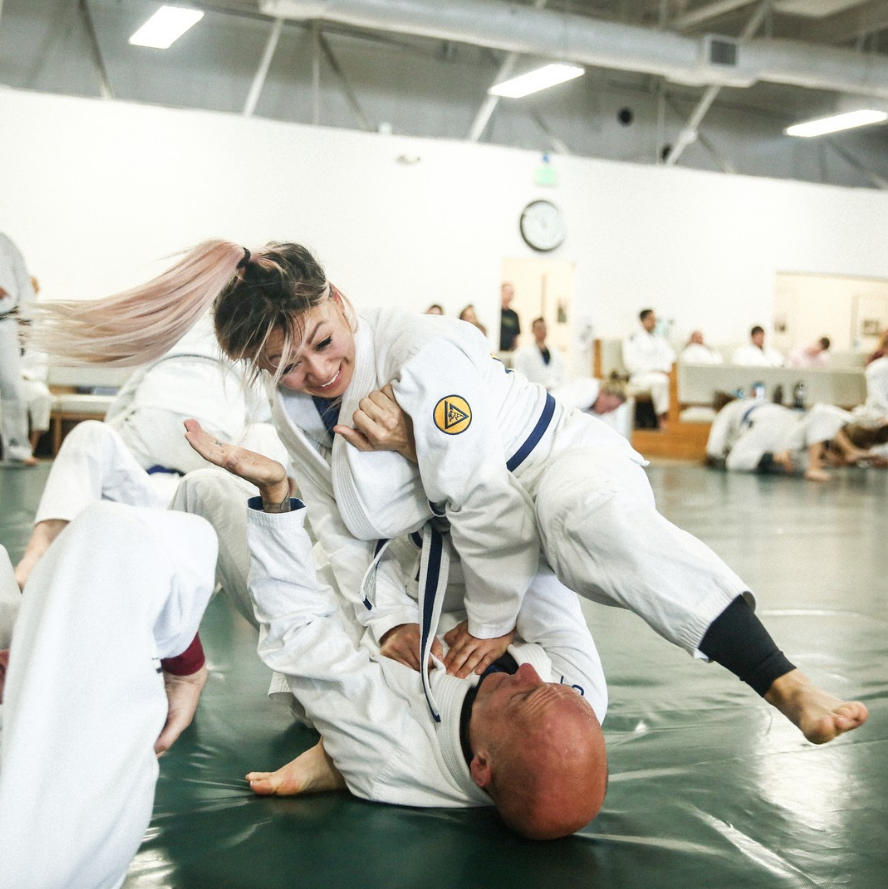
Jiu-Jitsu gives you an outlet that is both physical and mentally absorbing. You can’t scroll while someone is passing your guard. You can’t half-focus during live training. That forced presence is one of the hidden benefits: you get a break from your own noise.
From “always thinking” to “thinking clearly”
If you’re the kind of person who lives in your head, Jiu-Jitsu meets you there. You’ll analyze positions, patterns, timing, and leverage. Then you’ll test your ideas immediately. That loop builds a rare kind of confidence: the confidence of real feedback.
We often hear busy professionals say the same thing in different words: training helps your mind feel cleaner. Not empty, not numb. Just clearer.
The Social Side: Community Without the Awkwardness
San Jose can be surprisingly isolating. People are friendly, but everyone’s busy, and it’s easy to go from work to errands to home without real connection. Jiu-Jitsu solves that in a natural way because you’re working with partners from day one.
You learn names. You start recognizing people’s games and personalities. You celebrate small wins together, and you laugh at the weird moments (there are always a few). This isn’t forced networking. It’s earned familiarity.
Research on youth and adult programs often highlights increased pro-social behavior and improved social confidence, and we see that play out when beginners become regulars. You don’t have to be extroverted. You just have to show up.
What you actually build socially
Here’s what tends to develop over time, especially if you train consistently:
• Trust through safe, supervised training with clear boundaries
• Humility, because everyone taps and everyone learns
• Communication, because you give and receive feedback constantly
• Leadership, as you help newer students and model calm decision-making
• Belonging, because shared effort creates real connection
Those social skills carry into your work and family life in quiet, practical ways.
Safety, Scalability, and Why Beginners Belong Here
A common concern is whether Jiu-Jitsu is “too intense” for beginners, older adults, or people who haven’t exercised in a while. The truth is that it scales. We can adjust pace, intensity, and training partners, and we emphasize technical learning over ego-driven sparring.
Grappling does involve contact, but smart training keeps it sustainable. Tapping early is a skill. Control is a skill. Listening to your body is a skill. We coach all of it.
What your first few weeks usually feel like
Most beginners experience a predictable cycle:
1. Week 1: Everything feels new, but you leave energized
2. Weeks 2 to 4: You start recognizing positions and surviving longer
3. Month 2: Your movement improves and your cardio stops “panicking”
4. Months 3 and beyond: You begin solving problems instead of reacting
That timeline varies, but the pattern is real. And once you get that first clear moment of progress, Jiu-Jitsu tends to stick.
Adult Jiu-Jitsu in San Jose, CA: Growth That Fits Real Life
Adult Jiu-Jitsu San Jose, CA isn’t just about learning to fight. For most adults, it’s about becoming harder to knock off course. You learn to stay calm when someone is applying pressure. You learn to escape, reset, and try again. That is a life skill.
We structure adult classes to deliver both fundamentals and ongoing depth. You’ll learn self-defense principles, positional strategy, and controlled live training so you can apply what you learn. The combination is what drives personal growth, because it’s not theoretical. It’s practiced.
And yes, the fitness changes happen too. Your endurance climbs, your body composition improves, and you’ll likely feel stronger in daily tasks. But the deeper shift is how you respond to stress.
Jiu-Jitsu San Jose, CA: A Better Kind of Confidence
Confidence is often misunderstood. Loud confidence is easy to fake. Quiet confidence takes work. Jiu-Jitsu builds the quiet kind because it forces honesty and rewards consistency.
Recent studies and practitioner reports also suggest confidence gains can outpace those seen in some traditional martial arts, likely because the feedback loop in grappling is immediate and undeniable. When you solve a problem against resistance, you know it’s real. That reality becomes fuel.
We also like the non-aggressive philosophy built into good training. Control matters. Safety matters. Respect matters. You can train hard without becoming a harder person to be around.
How Our Program Fast-Tracks Growth (Without Rushing You)
Fast-tracking personal growth doesn’t mean rushing technique. It means removing friction so you can train consistently and learn efficiently.
We do that with:
• A fundamentals-first curriculum that gives you quick wins
• A class schedule with regular adult training opportunities throughout the week
• Coaching that emphasizes safety, control, and repeatable techniques
• A belt progression path that keeps you motivated and accountable
• A community culture where you can train seriously without ego
You’ll still have challenging days, of course. But you’ll have a structure that makes improvement predictable.
Take the Next Step
If you want a practice that strengthens your body, steadies your mind, and builds real confidence in San Jose, we’re ready to guide you. At Gracie Jiu-Jitsu San Jose, our focus is simple: teach Jiu-Jitsu in a way that supports measurable personal growth, not just a tough workout.
You can start with a free trial, follow the class schedule that fits your week, and build from fundamentals into deeper skill over time. The sooner you begin, the sooner you’ll feel that calm competence showing up everywhere else.
Continue your Jiu-Jitsu journey beyond this article by joining a class at Gracie Jiu-Jitsu San Jose.