
Jiu-Jitsu turns everyday stress into a skill set you can actually practice, measure, and improve.
In San Jose, life moves fast, and stress has a way of stacking up quietly: long workdays, traffic, screens, deadlines, and the feeling that you should be doing more to stay healthy and capable. We meet a lot of adults who want something practical, not trendy, and definitely not another routine that burns out in two weeks. That is exactly where Jiu-Jitsu fits.
We focus on real-world resilience, not just “getting in shape” or collecting techniques you never pressure-test. When you train with clear structure, supportive coaching, and a plan you can follow even when you are busy, you build strength that shows up outside the mat too: calmer decision-making, better energy, and a kind of confidence that does not depend on luck.
This article breaks down how our approach to Adult Jiu-Jitsu San Jose, CA training develops resilience in a way that makes sense for adults with real schedules and real responsibilities, especially here in Jiu-Jitsu San Jose, CA where stress can feel like part of the weather.
What We Mean by Real-World Resilience
Resilience is not just toughness. For adults, it is the ability to stay functional under pressure and return to baseline faster after stress. On the mat, pressure is obvious: someone is trying to control you, your breathing changes, and you have to solve problems with limited time and limited space. That is a very honest training environment.
Our goal is to help you build resilience in three layers. Physical resilience is the ability to move well and keep going safely. Mental resilience is the ability to think clearly when you are uncomfortable. Emotional resilience is the ability to stay calm enough to make choices, not reactions.
Jiu-Jitsu makes those layers measurable because you can feel the difference between panic and composure. You can also track progress in a way that is not vague. You either remember the detail, hit the timing, and keep your base, or you do not. That feedback loop is what changes you.
Why Jiu-Jitsu Works for Busy Adults in San Jose
San Jose has a lot of driven professionals. Many of us are paid to think, plan, and solve complex problems, but the body still takes a hit when you are sedentary, tense, and always “on.” Jiu-Jitsu gives you a reset that is physical, mental, and surprisingly clarifying.
One underrated part is the way training changes your relationship with discomfort. In class, discomfort is controlled and temporary. You learn to breathe through it, reposition, and problem-solve. Over time, that carries into daily life: meetings, family stress, conflict, and those moments when you feel your brain spinning up for no good reason.
We also see a practical benefit for urban living. Even if you never plan to fight, having self-defense context changes how you carry yourself. Posture, awareness, and boundaries improve because you are training your body to respond with structure instead of freezing.
Our Beginner-Friendly Structure: Gracie Combatives
Adults often avoid martial arts because they assume it will be chaotic, competitive, or physically punishing. We built our beginner program to be the opposite of that. Our Gracie Combatives curriculum is structured, progressive, and designed for absolute beginners. You do not need “to get in shape first.” You start where you are.
The program teaches 36 core self-defense techniques and builds them in a consistent class format. Each class typically includes one standing technique and one ground technique, so you learn to handle common situations from multiple ranges without feeling overwhelmed.
Just as important, we teach in a no-sparring environment during this phase. That does not mean it is easy. It means you can focus on learning, repetition, and control before adding intensity. For many adults, that is what makes training sustainable.
What You Learn in the 36-Technique Blueprint
This is not random technique-of-the-day training. The point of a blueprint is that it creates repeatable competence. As you move through the curriculum, you begin to notice patterns: posture, base, leverage, distance, and timing.
Our beginner training emphasizes skills that support real-world resilience, including:
- How to manage distance and clinch safely when space is tight
- How to escape from common holds and pins without relying on strength
- How to control an aggressor long enough to create an exit
- How to protect your head and maintain composure on the ground
- How to stay technical when your heart rate spikes
Because the curriculum is consistent, you can miss a week due to work travel and still know where you are when you return. That matters in real adult life.
Resilience on the Mat: Stress Training Without the Chaos
A big part of resilience is learning how your nervous system reacts. Many adults do not realize how quickly breathing becomes shallow when pressure shows up. Jiu-Jitsu makes that obvious within minutes, and that is a good thing because it gives you a place to practice regulation.
We coach you to slow down, use frames, protect posture, and make small decisions instead of exploding. That kind of training builds self-control. You learn that you can be uncomfortable and still be safe. You can be tired and still think.
Over time, students report that stress feels less sticky. You finish class sweaty and a little sore, sure, but your mind often feels cleaner. Sleep quality improves for many adults because training drives healthy fatigue and helps the body cycle out of “always alert” mode.
Physical Benefits That Support Everyday Capacity
When adults talk about fitness, it often becomes all-or-nothing: either an intense program you cannot maintain, or a light routine that never changes your body. Jiu-Jitsu sits in a middle ground that is challenging and scalable, and that is why it supports long-term health.
Training uses dynamic movement, isometric tension, and mobility under load. Over weeks and months, students commonly improve flexibility, heart and lung capacity, and general coordination. There is also a metabolic angle that matters as we age. Consistent training supports healthier blood sugar response and can contribute to improved cholesterol markers, especially when paired with reasonable nutrition and sleep.
It also builds body awareness. You start noticing how you stand at your desk, how you breathe in traffic, and how much tension you carry in your shoulders. That awareness sounds small, but it is the foundation for injury prevention and energy management.
Mental Resilience: Strategy Beats Brute Force
One reason Jiu-Jitsu is so effective for adults is that it rewards thinking. You can be strong and still get stuck if your positioning is wrong. You can be smaller and still succeed if your timing and leverage are better.
This strategic element is not just “cool” in a martial arts way. It is brain training. You practice reading cues, anticipating reactions, and selecting options under pressure. That kind of focused problem-solving can sharpen attention and improve mood. Many adults say class is the one hour where work noise finally drops out, not because you are distracted, but because you are fully present.
We also like the humility built into the process. You learn quickly that improvement is not about ego. It is about reps, details, and showing up even when you are not feeling like a superhero.
Measurable Progress: Attendance Cards and Video Support
Adults are busy, and motivation comes and goes. Structure keeps you moving forward even when life gets loud. As a Certified Gracie University Training Center, we use tools that make progress visible. Attendance cards help you track consistency, and video reviews support your learning between classes.
This matters because resilience is built through repetition, not inspiration. When you can see your progress, you trust the process more. You stop wondering if you are “doing enough” and start focusing on the next class, the next detail, the next improvement.
Our environment is collaborative by design. Partners help each other learn, and that changes the feel of training. You are not walking into a room where you must prove something. You are walking into a room where you can practice something.
How Long Until You Feel a Real Change
Adults want honest expectations. You will feel something immediately: you will be tired, you will learn new movements, and you will probably sleep well. But the deeper changes build over time.
Most students notice a shift in confidence and composure within the first month, mostly because you start understanding positions and you stop feeling lost. Within a few months, the physical benefits become obvious: improved mobility, stronger posture, and better conditioning. As you continue working through the 36 core techniques, you build a dependable self-defense foundation that feels less like theory and more like capability.
Resilience is not a finish line. It is a practice. The goal is that your baseline becomes stronger and calmer, and your recovery from stress becomes quicker.
What a Typical Class Feels Like
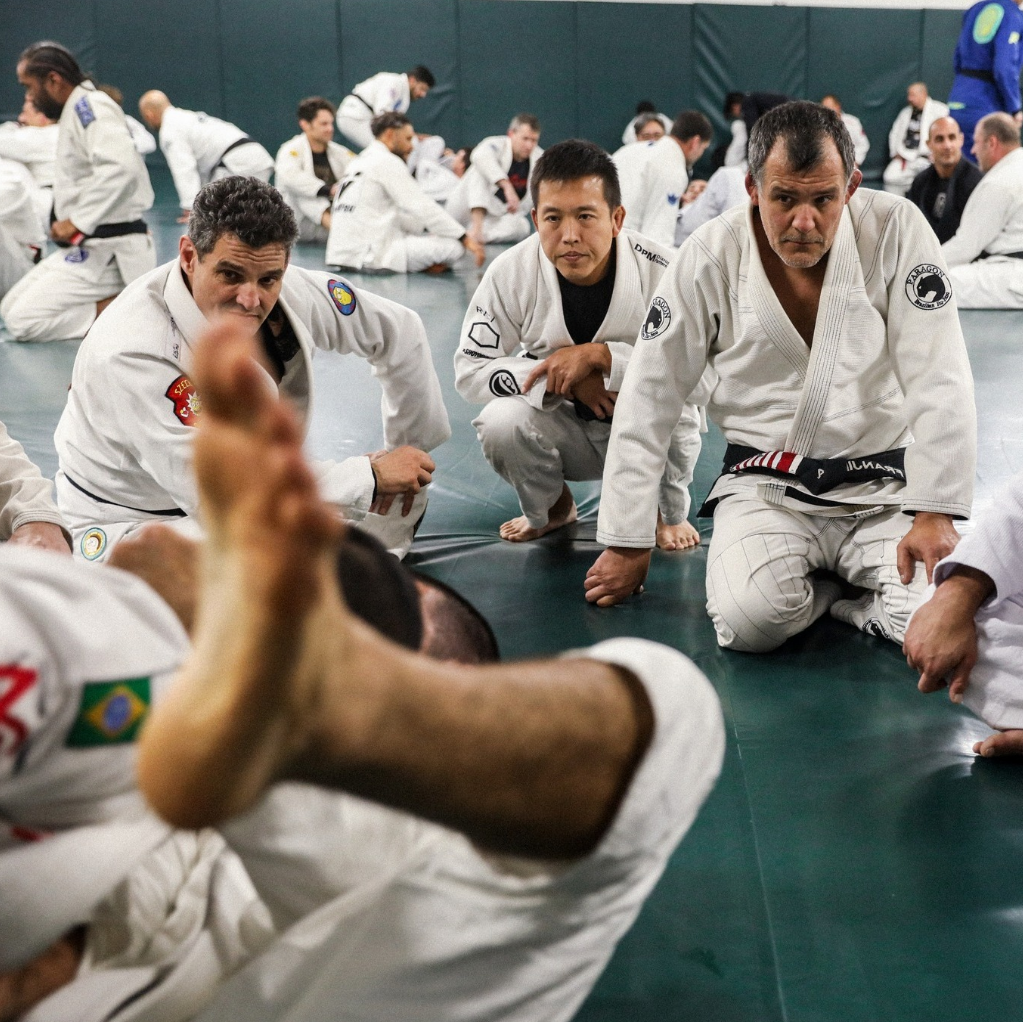
A good class should feel challenging but not chaotic. We keep the learning clear and the pace manageable. You will drill techniques with a partner, ask questions, and get corrections that help you improve right away. Expect a mix of focus and movement. Some days you will leave feeling powerful. Some days you will leave thinking, “Wow, that detail mattered more than I expected.” That is normal.
We also pay attention to safety. Adults have old injuries, tight hips, and jobs that require them to function the next day. We train hard, but we train smart. Resilience includes durability, and durability includes learning how to pace yourself and communicate.
Getting Started Without Overthinking It
If you are interested but hesitant, that is normal too. Starting is often the hardest part, mostly because you do not know what to expect. Here is the simplest way to approach it:
1. Check the class schedule page and pick a time you can realistically repeat each week
2. Show up a little early so you can settle in and ask questions without rushing
3. Train the class as a beginner, focusing on learning, not performing
4. Use the video support to review what you learned and reduce mental overload
5. Stay consistent long enough to feel the compounding effect of repetition
Consistency beats intensity. That is not a slogan. It is how adults actually get results.
Take the Next Step
If you want resilience that you can feel in your body and trust under pressure, our approach is built for that. We teach Jiu-Jitsu in a structured way that works for beginners, supports measurable progress, and stays anchored in real-world self-defense and adult wellness.
Training is not about becoming aggressive. It is about becoming capable, calmer, and harder to shake. At Gracie Jiu-Jitsu San Jose, we keep the path clear: start with Gracie Combatives, build your foundation, and let the benefits carry into the rest of your life in San Jose.
Train with experienced instructors and a supportive team by joining a Jiu-Jitsu class at Gracie Jiu-Jitsu San Jose.