
Jiu-Jitsu turns fitness into usable strength you can feel at your desk, on your commute, and at home.
San Jose is full of people who work hard, sit a lot, and carry stress in sneaky places like the neck, hips, and low back. So when you ask us what “getting stronger” should really mean, we usually point away from mirror muscles and toward everyday strength: the kind that makes you more capable in real life.
That is where Jiu-Jitsu fits San Jose so well. It is a full-body practice built on leverage, positioning, breathing, and controlled intensity. You build strength without needing to move heavy weight on day one, and you learn how to apply that strength with timing and technique instead of just effort.
In our Adult Jiu-Jitsu San Jose, CA classes, we see the same pattern again and again: you start for fitness or stress relief, then you notice your posture improving, your joints moving better, and your confidence rising in places you did not expect. That is not hype. It is what consistent training does when the work is practical and progressive.
What “everyday strength” really means in San Jose
Everyday strength is not a single measurement. It is a blend of qualities that help you handle life with less strain and more control. For busy adults in Jiu-Jitsu San Jose, CA, that usually shows up in small wins that add up.
Strength you can use, not just display
When you train, you learn to create force through your whole body, from your feet to your hands, while staying balanced. That matters when you pick up a kid, carry groceries up stairs, or brace yourself on a crowded light rail. Our training constantly asks you to stabilize, base, and move under pressure, and that is the kind of strength daily life demands.
Endurance for long days, not just short workouts
San Jose schedules can be intense. A workout that leaves you wrecked is not always helpful if you still have meetings, traffic, and family responsibilities. Jiu-Jitsu builds muscular endurance and cardiovascular capacity through drilling, positional training, and controlled sparring. Research on Brazilian Jiu-Jitsu shows improvements in cardio health, strength, flexibility, and agility because it is a true full-body workload, not a single-plane gym routine.
Mobility and joint resilience as a priority
A lot of adults think “strong” means tight. We disagree. If your hips do not rotate well or your shoulders are stiff, daily movement feels harder than it should. Jiu-Jitsu develops practical mobility because you move through real ranges: hip escapes, bridges, technical stand-ups, guard work, and rotational finishes that teach your body how to stay safe while moving.
Why Jiu-Jitsu builds strength fast for beginners
If you are new, you might worry that you need to “get in shape first.” We hear that a lot. The truth is that beginners can start building strength immediately because our approach does not rely on brute force. It relies on repeatable mechanics.
Leverage beats raw strength, and that is a relief
In Jiu-Jitsu, angles matter. Frames matter. Base matters. When you learn to connect your skeleton and hips correctly, you can hold posture, keep balance, and maintain pressure without straining your neck or arms. That is real strength, built through intelligent effort.
Drills build the kind of strength weights often miss
Lifting can be great, but it does not always teach you how to coordinate your whole body while someone is trying to move you. Drilling does. Repeating a movement like a hip escape trains core endurance, hip mobility, and timing all at once. Then you repeat it again, and it becomes part of you.
You progress in layers, not leaps
We structure training so you can improve without feeling thrown into chaos. You learn positions, then transitions, then how to stay calm while applying them. Studies comparing advanced belts to beginners show that more experience correlates with better resilience, grit, and self-efficacy. In other words, the longer you train, the more strength shows up both physically and mentally, and you can feel that build over time.
The physical changes you can expect from consistent training
We like to keep promises realistic, because adults have enough pressure already. Still, the physical adaptations from steady Jiu-Jitsu training are hard to miss.
Here is what many students notice with 2 to 3 sessions per week:
• Better grip and forearm endurance from controlling sleeves, collars, and clinches, especially in gi training
• Stronger hips and core from bridging, guard retention, and maintaining posture under pressure
• Improved cardio from rounds that spike your heart rate, then teach you to recover with breathing
• More flexible shoulders, ankles, and hips as your body learns to move in useful ranges
• A more “athletic” feel in daily movement, like getting up off the floor or turning quickly without stiffness
Those benefits line up with what current research highlights: Brazilian Jiu-Jitsu improves muscular endurance, flexibility, agility, and cardiovascular fitness through its mix of drills, takedowns, sweeps, and sparring.
The mental side of everyday strength: calm under pressure
San Jose is a tech hub, but it is also a pressure cooker at times. Deadlines, commutes, family logistics, and a constant stream of notifications can make you feel like your brain never fully shuts off. Jiu-Jitsu helps because it gives you a focused problem to solve, right now, with your whole attention.
Stress reduction you can actually feel
Hard training releases endorphins, and it also creates a kind of mental reset. You cannot half-focus while someone is passing your guard. You learn to breathe, make decisions, and stay present. Recent survey-based research trends show a large majority of practitioners report reduced anxiety, improved mood, confidence, and a stronger sense of community, with many also reporting that life skills like discipline and focus carry over into daily life.
Confidence built through evidence, not pep talks
A quiet benefit of Jiu-Jitsu is that you collect proof that you can do hard things. You learn a skill, test it live, adjust, and improve. That process builds self-control and self-efficacy over time, which research also supports when comparing higher belts to newer students.
Neuroplasticity in plain language
Your brain adapts when you learn complex movement and problem-solving under constraints. Jiu-Jitsu is basically that, over and over. You recognize patterns faster, stay calmer longer, and make better choices under stress. That is everyday strength in the most practical sense.
What training looks like in our adult program
If you have never trained before, the unknown is often the hardest part. We keep classes structured and welcoming, and we emphasize control. You will sweat, but you will also learn, and that combination is what keeps adults coming back.
A typical class flow
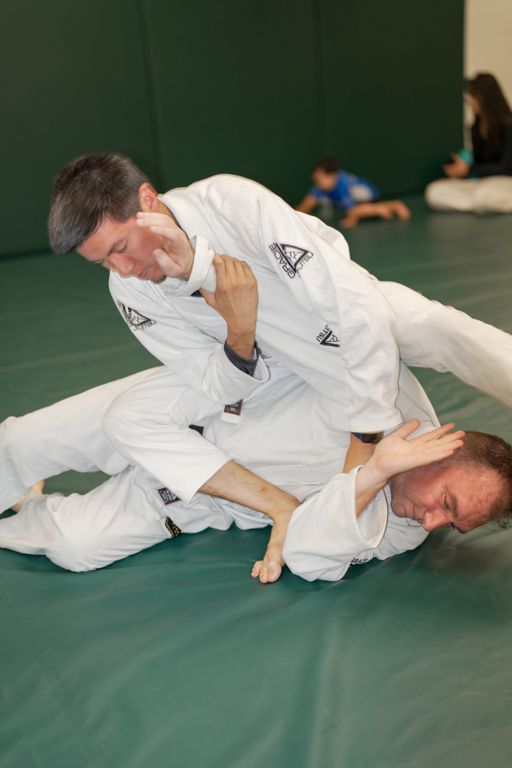
Most sessions include a warm-up that supports mobility and safe movement, technique instruction with clear details, drilling with a partner, and optional live training at an intensity that matches your level. Live rounds are where your conditioning grows quickly, but we scale them so you can stay consistent instead of getting crushed and disappearing for a month.
Gi and no-gi both have a purpose
Gi training builds grip strength and teaches you to control distance through fabric grips, while no-gi tends to emphasize speed, underhooks, and tighter body control. Both improve athleticism, and both teach you to move with efficiency.
Your first few weeks, realistically
In the beginning, you will learn how to survive positions, how to tap early, and how to breathe through discomfort. You will also feel muscles you forgot existed. That is normal. The goal is not to win rounds. The goal is to build a base that supports your health and your progress.
How to start without overthinking it
Starting is easier when you have a simple plan. If you want a clear approach, here is what we recommend:
1. Pick 2 or 3 class days you can protect on your calendar, because consistency beats intensity
2. Start with fundamentals and focus on clean movement, not “going hard”
3. Track small markers like improved breathing, better balance, and fewer tense shoulders
4. Ask questions in class, because one detail can save you months of frustration
5. Give yourself 6 to 8 weeks to feel the real shift in conditioning and confidence
That timeline matches what many adults experience: noticeable changes in weeks through drilling, with bigger physical and mental benefits building as training experience accumulates.
Safety, longevity, and training when your body has history
A lot of adults in San Jose have old sports injuries, desk-job stiffness, or the general “my knee is weird sometimes” situation. We take that seriously. Jiu-Jitsu can be practiced in a controlled way that prioritizes longevity.
Why controlled training matters
Because Jiu-Jitsu includes clear tapping and position-based learning, you can train hard without needing chaotic impact. You learn to communicate, slow down, and choose safer options. Research and trends also highlight BJJ’s role in injury reduction and rehabilitation-focused movement when training is managed intelligently.
Practical ways we help you stay healthy
We coach you to build strong frames instead of muscling through bad angles, to avoid fighting out of submissions late, and to pace your rounds. You will still work, but you will work with intention. Over time, that develops injury resilience because your body learns better mechanics, better balance, and better awareness.
Why this resonates so strongly in San Jose right now
Jiu-Jitsu is not just popular because it looks cool. It works for modern life. In a city where many adults spend long hours sitting, managing stress, and trying to stay active without wrecking their bodies, training that builds strength, mobility, and mental steadiness is a smart match.
We also see something else happen: people find a community that makes showing up easier. That is not a small thing. When your training partners know your name and your progress, consistency becomes normal. And consistency is where everyday strength really comes from.
Take the Next Step
Building everyday strength is not about becoming a different person overnight. It is about stacking small, repeatable efforts until your body feels capable and your mind feels steadier. That is what Jiu-Jitsu delivers when training is structured, progressive, and consistent.
If you want a place to start with clear coaching and a practical approach, we built our Adult Jiu-Jitsu San Jose, CA program to meet you where you are. At Gracie Jiu-Jitsu San Jose, you can train for fitness, confidence, and real-world strength in a way that fits San Jose life, not a fantasy schedule.
Improve your fitness, confidence, and grappling ability by joining a Jiu-Jitsu class at Gracie Jiu-Jitsu San Jose.