
Jiu-Jitsu has a quiet way of upgrading your daily life, one controlled round at a time.
In San Jose, adult life moves fast: long workdays, family calendars, traffic, and a brain that rarely gets to fully unplug. We built our Jiu-Jitsu program for that reality, not for some fantasy schedule where you have endless free time and perfect recovery. If you want training that strengthens your body, sharpens your decision-making, and builds discipline you can actually keep, you are in the right place.
San Jose also happens to be a major hub for Brazilian Jiu-Jitsu competition, with local tournaments drawing hundreds of adult competitors and awarding hundreds of medals across deep divisions. That level of participation tells us something important: people here care about skill, consistency, and real progress. We take that same seriousness and apply it to your training, whether you ever plan to compete or not.
What you will notice quickly is that adult growth is not just about learning techniques. It is about building a system you can repeat. Our classes, our coaching, and the way we scale intensity are designed to help you train for years, not weeks.
Why adult Jiu-Jitsu works so well in San Jose
San Jose has a unique mix of driven professionals, active families, and competitive athletes, all sharing the same challenge: limited time and high mental load. Jiu-Jitsu fits because it rewards focus more than raw aggression, and because you can improve even on weeks when you do not feel like a superhero.
Our adult students often tell us the same thing in different words: the mat becomes the one place where the noise drops. You have a clear problem in front of you, and you work it. That mental reset is not accidental. Jiu-Jitsu demands presence, and presence is a skill you carry back into your workday.
The local competition scene reinforces the culture of consistent training. For example, IBJJF San Jose gi events in 2024 drew roughly 381 to 388 fighters across 208 divisions and awarded nearly 500 medals at a time, while a 2024 San Jose no-gi event still drew 125 fighters across 93 divisions. You do not need those numbers to motivate you, but it helps to know you are training in a city where the art is taken seriously.
Discipline you can feel Monday morning
Discipline is not just willpower. For adults, discipline is structure: knowing when you train, what you train, and how you measure improvement without burning out. We keep your training grounded in fundamentals so your progress stays stable even when life gets chaotic.
In our program, discipline shows up in simple habits:
- You learn to arrive with a plan, warm up with purpose, and start rounds safely
- You practice finishing mechanics step by step instead of forcing speed
- You build the ability to stay calm under pressure, then apply that calm to hard conversations and deadlines
Jiu-Jitsu has an honest feedback loop. If you skip details, the position falls apart. If you breathe and frame correctly, you create space. That kind of truth is refreshing, and it makes discipline feel less like punishment and more like competence.
Agility for adults: mobility, balance, and timing
When people hear agility, some think ladder drills or sprint work. In Jiu-Jitsu, agility is more practical: hip movement, base, posture, angles, and timing. We train you to move efficiently, which matters even more as you get older and want your body to feel good tomorrow.
A lot of adult athleticism is really just coordination under pressure. For example, learning to retain guard is not only about flexibility. It is about recognizing grips early, using your frames, turning your hips at the right moment, and recovering position without panicking. That is agility you can build at any age, and it shows up in daily life as better balance and fewer awkward tweaked movements.
We also balance intensity with longevity. You will still work hard, but we do not treat “hard” as the only setting. Skillful movement is the goal, and the conditioning follows.
Lasting growth means playing the long game
If you are an adult, you probably want results, but you also want the results to stick. A recent survey of nearly 2,000 practitioners reported average belt timelines that look like this: about 2.3 years to progress from white, about 2.3 years to earn blue and roughly 3.3 years spent at blue, around 5.6 years to purple, and around 9.0 years to brown. In other words, real Jiu-Jitsu growth is measured in years, not weekends.
We like that reality, because it matches what adults actually need: a training practice that keeps paying you back. Our coaching focuses on foundation, timing, and decision-making so you are not collecting techniques like clutter. You are building a game you can rely on.
And yes, growth has seasons. Some months you feel sharp. Some months you feel like you forgot everything. Both are normal. Our job is to keep your progress trending upward by refining your basics and helping you train consistently.
What Adult Jiu-Jitsu San Jose, CA training looks like in our classes
We coach adults with a clear progression: learn the position, learn the escape, learn the control, then build offense. That sequence protects you, because it means you do not need to “win” practice to get better. You need to understand what is happening.
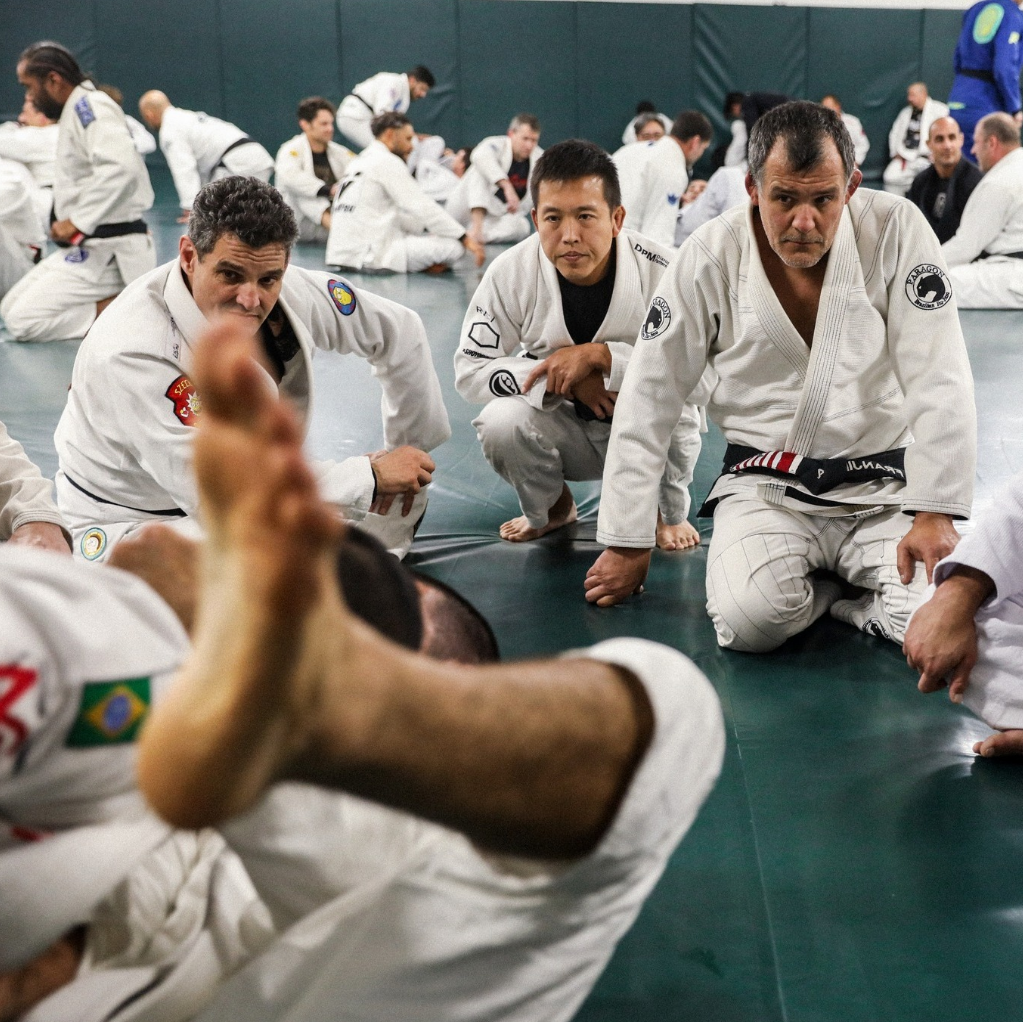
A typical class in our Adult Jiu-Jitsu San Jose, CA program includes technical instruction, drilling, and controlled sparring. You will work with partners of different sizes and styles, and we help you learn how to adapt without turning every round into a scramble. Some days feel smooth. Some days feel like puzzle-solving with your lungs. That mix is part of the process.
We also keep our class culture respectful and focused. You should be able to train hard and still go back to work the next day without feeling wrecked. That is a standard, not a bonus.
Gi vs no-gi: which one builds agility and discipline better?
San Jose’s tournament scene shows a clear trend: gi events tend to attract larger fields, and no-gi events still pull dedicated competitors who enjoy the faster pace. From a training standpoint, both styles develop valuable attributes, and we guide you so you understand the “why” behind each.
The gi slows things down enough for you to study grips, posture, and layered control. That naturally builds discipline, because sloppy movement gets exposed by friction and grips. No-gi tends to emphasize connection, pressure, and quick transitions. That challenges your agility and your ability to stay composed when positions change fast.
If your goal is self-defense, overall athletic development, and long-term skill, we recommend learning both over time. The best approach is not picking a side. It is building fundamentals that transfer.
Safety and injury prevention for working adults
Adults ask about injury risk for a reason. A widely cited study found that 59.2 percent of athletes reported at least one injury in the prior six months, with risk increasing with higher training frequency, while experience tends to reduce injury rates. The takeaway is not “do not train.” The takeaway is “train smart.”
We build safety into the program through coaching, partner selection, and intensity management. You will learn how to tap early, how to protect your neck and shoulders, and how to avoid the common mistake of resisting the wrong way at the wrong time.
Here are practical guidelines we coach from day one:
- Aim for 2 to 3 classes per week at first so your joints and nervous system adapt
- Prioritize clean escapes and frames before chasing submissions
- Communicate with partners about pace, especially when you are new or returning
- Treat drilling as skill practice, not a competition
- Ask us questions when something feels off, because small issues become big ones when ignored
In other words, safety is a skill. We teach it like one.
Time commitment: what progress looks like on a busy schedule
Most adults want an honest answer: how much do you need to train for real progress? We see consistent improvement with 2 to 3 sessions per week, especially when you repeat the fundamentals and keep notes on what you are learning. More training can accelerate growth, but only if your recovery, sleep, and stress are in a good place.
We also design our class schedule to be realistic for San Jose adults. Evening training windows matter, and we keep the flow of classes structured so you can show up after work, train with focus, and leave feeling better than when you walked in. Not every day will feel perfect. Consistency still wins.
If you want to compete one day, we can guide you toward that too, but our baseline promise stays the same: you will build skill you can use and keep.
A simple roadmap for getting started and sticking with it
Starting is easier when you know what to expect. Here is the training rhythm we recommend for most adults who want discipline, agility, and lasting growth:
1. Start with a trial class and focus on learning how class works, not on performing
2. Train twice per week for the first month, keeping intensity controlled and consistent
3. Add a third class when your body feels adapted and your movement feels less tense
4. Choose two positions to study each month, like guard retention and side control escapes
5. Reassess every eight to twelve weeks so your goals match your real life schedule
That structure keeps your progress steady. It also helps you avoid the on and off cycle that frustrates so many adults.
Take the Next Step
Building discipline and agility is not about finding motivation every day. It is about training in a way that makes motivation less necessary. That is the heart of what we do, and it is why our adult Jiu-Jitsu program stays focused on fundamentals, safety, and repeatable progress.
If you are ready to train with a method that respects your time and supports long-term growth, we would love to welcome you at Gracie Jiu-Jitsu San Jose. You will get clear coaching, a structured class experience, and a community that values skill development over ego, which honestly makes training a lot more enjoyable.
Ready to train? Join a Jiu-Jitsu class at Gracie Jiu-Jitsu San Jose today.