
Jiu-Jitsu gives San Jose families a shared routine that replaces screen time with real connection, challenge, and growth.
In San Jose, family schedules can feel like a constantly shifting calendar invite, and it is easy to drift into separate routines even when you care deeply about being close. We see many families looking for something that is healthy, structured, and genuinely fun to do together, without needing a whole weekend to make it happen. Jiu-Jitsu fits that reality well because it rewards consistency more than intensity.
Brazilian Jiu-Jitsu is also having a moment for a reason. Search interest has risen dramatically over the last two decades, and there are now hundreds of thousands of practitioners in the US, which tells us something simple: people stick with this. Not because it is trendy, but because it keeps giving you new problems to solve, week after week.
When your family trains together, the benefits stack in practical ways. You get a shared language for effort, calm under pressure, and respect for boundaries, and those lessons show up at home, at school, and at work.
Why Jiu-Jitsu works so well for busy San Jose families
San Jose is full of driven people, and that drive can be a gift and a stressor at the same time. Between tech commutes, homework, sports, and the never-ending pull of devices, families often want an activity that builds resilience without adding chaos. Our training environment is structured and predictable, which is surprisingly calming for both kids and adults.
Jiu-Jitsu is also uniquely scalable. You can start at different ages and fitness levels, and still train side by side. Because the art is based on leverage and timing, you are not required to be the strongest person in the room to make progress. That makes it a better fit for family training than activities where size, speed, or raw athleticism dominate the experience.
And unlike many hobbies where you mostly watch, Jiu-Jitsu keeps you present. You cannot half-participate while thinking about emails. You are engaged, breathing, moving, and learning. For families, that kind of shared attention is rare, and honestly, it is refreshing.
Confidence you can see, not just feel
Confidence is often talked about like it is a personality trait, but we treat it like a skill. You build it through small wins that add up: learning how to fall safely, how to escape a bad position, how to stay calm when you are uncomfortable, and how to try again without spiraling. Over time, students stop needing constant reassurance because the proof is in the reps.
Research and surveys within the sport consistently show strong cognitive benefits, including problem-solving improvements, with many practitioners reporting that training helps them think more clearly under pressure. That lines up with what we see daily on the mats. Jiu-Jitsu is physical chess at full speed, and you cannot brute-force your way through every moment. You learn to pause, frame, breathe, and make a better choice.
For kids, confidence tends to show up in posture and voice first. Parents often tell us school mornings get smoother, social stress feels less overwhelming, and kids handle correction better because they are used to feedback in class. For adults, confidence often looks quieter: less tension in the shoulders, more patience in traffic, and a sense that you can handle difficult conversations without getting rattled.
Stronger family bonds through a shared challenge
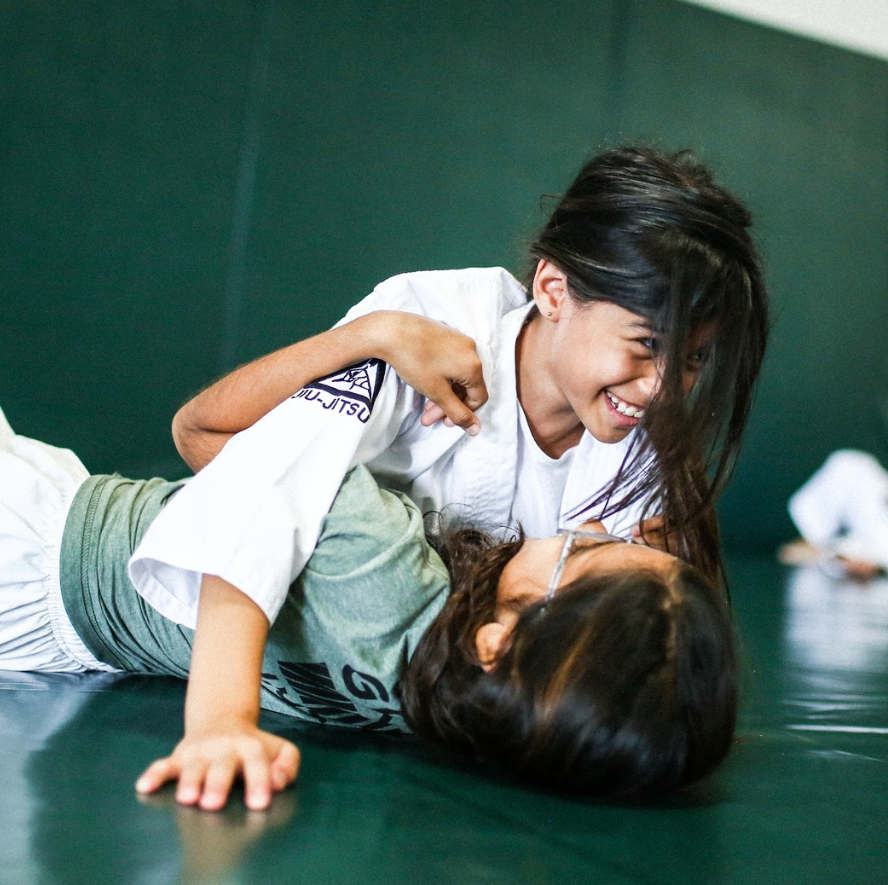
Family bonding does not always happen in big, dramatic moments. Most of the time, it happens in small rituals. Training creates a ritual that is healthy and consistent: the drive over, tying the belt, warming up, learning something new, laughing a little when it does not click right away, then heading home with that calm tiredness.
One of the overlooked parts of Jiu-Jitsu is that it teaches respectful physical communication. You learn to ask partners if pressure is okay, to tap early, to reset without ego, and to be responsible for the safety of someone else. Those habits carry into family dynamics in a grounded way. Boundaries become normal, not awkward, and cooperation becomes practical, not theoretical.
It also gives families a shared experience where everyone is learning. That matters because kids can sense when an activity is only for them, and adults are just chauffeuring. When you train too, you model effort, humility, and persistence, and your kids notice.
What family-friendly training looks like in our academy
We build our programs to be welcoming for beginners and realistic for family schedules. That means clear fundamentals, organized classes, and an emphasis on safety and progress. You do not need prior martial arts experience. You just need the willingness to learn and the patience to be new at something, which is a real skill by itself.
We also keep the atmosphere supportive. You will work with partners who understand that families are here to grow, not to prove something. Training can be challenging, but it should not feel intimidating.
Here is what you can generally expect from a family-focused experience with us:
• Fundamentals first, so you build confidence without feeling rushed
• Technique-focused training that reduces injury risk and supports longevity
• Clear boundaries around tapping, control, and respectful partnering
• A culture where questions are welcome and progress is celebrated
• Coaching that helps you translate what happens in class into daily life
Safety for kids and beginners: how we keep training smart
Safety is one of the first questions families ask, and it should be. Jiu-Jitsu is a grappling art, so we take control, tapping, and supervision seriously. We teach students how to apply techniques with care and how to recognize when to stop. That culture matters more than any single rule.
It helps to know that modern competition data shows many finishes are chokes, and while that can sound scary on paper, in training it is controlled and monitored closely, with tapping and quick resets. In day-to-day classes, we focus on learning, not winning. We would rather you leave feeling better than when you arrived.
For kids, we keep instruction structured and age-appropriate. We emphasize movement skills, balance, coordination, and confidence, and we coach the social side too: how to be a good partner, how to listen, how to handle frustration. Those are life skills wearing a martial arts uniform.
For adults, we help you scale intensity. If you are returning to fitness, sitting a lot for work, or managing old injuries, we adjust training so you can build momentum without feeling wrecked.
Gi vs no-gi for families: choosing what supports discipline and comfort
Families in San Jose often ask whether they should start in the gi or no-gi. Both are valuable, and we guide you based on your goals, your comfort level, and what fits your schedule.
Gi training tends to slow things down in a good way. The grips make movement more deliberate, and that encourages patience, precision, and a kind of discipline that kids respond to well. No-gi can feel more athletic and fast, which some students enjoy right away, especially if they play sports.
Interestingly, elite no-gi competition continues to show the value of gi foundations. Many top performers have strong gi backgrounds, and recent trends also show increased wrestling integration, which influences how takedowns and control are taught across both styles. For families, the takeaway is simple: fundamentals matter more than the uniform. We build those fundamentals so you feel confident in either format.
How Jiu-Jitsu supports school, sports, and work performance
The physical benefits are clear: improved fitness, better coordination, stronger grips, and healthier joints when training is done correctly. But the bigger win for many families is the mental carryover.
Jiu-Jitsu teaches you to solve problems while tired, while someone is resisting, and while you would really prefer an easier option. That is a pretty good mirror of modern life. You learn to break big challenges into small steps: recover guard, build a frame, create an angle, escape, reset. That pattern helps kids with homework and tests, and it helps adults with stressful projects and deadlines.
For young athletes, grappling skills also build body awareness and balance that translates into other sports. The current emphasis on wrestling-style takedowns in the broader sport reflects that crossover. Even if your child never competes, learning how to move another body safely and effectively can improve confidence in any physical activity.
For adults in high-pressure roles, training can become a reliable stress outlet. You get to practice calmness in a controlled environment, and that calmness tends to show up later when you need it.
Time commitment and realistic scheduling for families
Most families make steady progress training two to three times per week. More can be great, but consistency is the bigger lever. You do not need marathon sessions. A well-run class that fits into your week is often the difference between starting and sticking with it.
We recommend choosing training days like you choose brushing your teeth: not negotiable, not dramatic, just part of the rhythm. When you treat it like a normal appointment, your family adapts quickly.
If you are balancing multiple ages and activities, it helps to look at the class schedule and plan a simple routine for the first month. Once training becomes familiar, it stops feeling like one more thing and starts feeling like the thing that helps everything else go better.
Getting started: what to do before your first class
Starting a new activity as a family can feel like a lot, especially if you do not know what to wear or what the vibe will be. We keep the entry point straightforward and beginner-friendly, and we will walk you through it.
Here is a simple way to prepare so your first week goes smoothly:
1. Check the class schedule page and pick two realistic days you can repeat weekly.
2. Arrive a bit early so you can meet our team and get oriented without rushing.
3. Wear comfortable training clothes if you do not have a gi yet, and bring water.
4. Focus on learning one small detail per class, not being perfect.
5. Talk with us about family options and the pace that fits your goals.
Jiu-Jitsu rewards patience. If your first class feels like a lot of new information, that is normal. You are learning a new language with your body, and it clicks faster than you might expect.
Take the Next Step
If you want a family activity in San Jose that builds confidence, improves fitness, and creates real connection, we would love to help you start in a way that feels comfortable and sustainable. Our approach is built around clear instruction, a supportive environment, and training that respects beginners while still being genuinely effective.
When you are ready, Gracie Jiu-Jitsu San Jose is here with family-friendly programs and a class schedule that makes it realistic to train consistently. A few weeks of practice can change the tone at home in subtle ways, and those subtle changes tend to last.
Become part of a community committed to growth and respect by joining a Jiu-Jitsu class at Gracie Jiu-Jitsu San Jose.