
Jiu-Jitsu is a practice you can feel in your posture, your decision-making, and the way you handle pressure.
In San Jose, life moves fast, and a lot of us spend our days solving problems, juggling deadlines, and managing stress that never really announces itself. That is one reason Jiu-Jitsu fits so well here: it gives you a structured place to practice calm, focused effort, even when things get uncomfortable. We see it every week in adult students who walk in looking for fitness or self-defense and end up staying for the discipline that spills into the rest of life.
Brazilian Jiu-Jitsu has grown into a global sport with millions of practitioners, and the US scene alone has expanded rapidly in the last few years. But what matters most is what happens on the mat in a real class: you learn how to think clearly, keep showing up, and build skills that work under pressure. Interestingly, only about 20 percent of practitioners now train primarily for self-defense, yet roughly 75 percent report improved problem-solving from consistent training. That tells us something important: Jiu-Jitsu is not just about fights, it is about function.
If you are searching for Jiu-Jitsu San Jose, CA options and wondering what training actually does for an adult schedule, our goal here is simple: explain what you will learn, how the process works, and how to start in a way that is realistic for your life.
Why Jiu-Jitsu builds discipline faster than most fitness routines
Discipline is not a personality trait you either have or do not have. In our experience, it is a skill you build through repetition, feedback, and a system that makes progress visible. Jiu-Jitsu does that naturally because you cannot hide from the truth of the moment. If your posture breaks, you feel it. If your timing is off, you notice it. If you rush, you get tired and make mistakes.
A typical adult fitness plan often depends on motivation, and motivation comes and goes. Jiu-Jitsu depends on habits. You show up, you warm up, you drill, and you train with partners who are also learning. Over time, your brain starts to expect the routine. The mat becomes a weekly anchor, which sounds small, but it adds up.
Because the training is interactive, discipline becomes less about willpower and more about responsibility. You want to be a good partner. You want to remember the details. You want to improve one thing each class. That is how consistency becomes part of your identity without you forcing it.
The real-world skills you gain, even if you never compete
Jiu-Jitsu is famous for teaching a smaller person how to control a larger person through leverage, angles, and technique. But the deeper real-world benefit is the ability to solve problems while your heart rate is up. That is the part most people do not expect on day one.
Here are a few skills you can expect to build through consistent training:
• Pressure management: you learn to breathe, frame, and move even when you feel pinned
• Decision-making: you learn to pick a high-percentage option instead of panicking
• Boundary awareness: you learn where you are safe, where you are not, and how to recover
• Communication: you learn to train with partners respectfully, with clear taps and feedback
• Physical competence: you learn how to fall, base, stand, and move with purpose
Those are real-world skills because they translate. We have watched students carry that calm into tough work meetings, high-stakes presentations, and stressful weeks where sleep is not perfect. The mat does not fix everything, but it trains you to respond instead of react.
What makes adult training different in San Jose, CA
Adult Jiu-Jitsu San Jose, CA students often have one big constraint: time. Between work, commuting, family responsibilities, and the simple reality of being tired, training needs to be sustainable. Our approach is built around that reality. We would rather see you train two to three times per week for a year than go all-in for a month and disappear.
San Jose also has a unique culture. Many students come from tech and professional roles where performance is tracked and improvement is measured. That mindset actually works well in Jiu-Jitsu. You can treat your training like a long-term project: track attendance, note what positions give you trouble, and watch how your recovery affects performance. Wearables and recovery tools have become more common in the sport, and we like that trend, as long as the data supports smarter training instead of overtraining.
A practical timeline: what progress can look like in 3 to 6 months
People want to know when they will feel competent. The honest answer is that you will feel better quickly, and you will also feel humbled regularly. That is normal. Jiu-Jitsu has layers.
In the first few weeks, most adults notice improved conditioning and coordination. You start to understand basic positions and why certain mistakes keep happening. Somewhere around the second or third month, many students begin to recognize patterns: common grips, common escapes, and the idea that position comes before submission.
By three to six months, you can build a functional foundation. You are not trying to “win” every round. You are trying to survive intelligently, escape bad positions, and apply a small set of reliable techniques. That is a big deal in a short period of time, especially for beginners who started with zero grappling experience.
The modern evolution of Jiu-Jitsu: gi, no-gi, and why both matter
Jiu-Jitsu has evolved a lot. In recent years, no-gi grappling has accelerated, leg locks and heel hooks have become more prominent in competitive settings, and wrestling fundamentals have gained importance as the sport moves away from passive starts. We pay attention to those trends because they affect what works when someone is resisting hard.
At the same time, the gi remains a powerful teacher. It slows things down, demands clean grips, and punishes sloppy posture. Training both is not about chasing trends. It is about building a well-rounded skill set so you can adapt.
We also keep expectations realistic. Not every move is a high-percentage finish. For example, competition databases show some submissions like the omoplata have relatively low finishing rates overall. That does not mean they are useless. It means we teach you when a technique is best used as a control, a transition, or a trap that opens something else. Adults appreciate that kind of honesty.
How we structure training to build discipline without burning you out
A common reason adults quit Jiu-Jitsu is not lack of interest. It is overload. Too many hard rounds, too little recovery, and no plan for soreness or schedule disruptions. Our job is to help you train for the long game.
We emphasize a progression that gives you enough challenge to grow, without turning every session into a battle. Some classes focus more on drilling and positional training. Some include more live rounds. And we always prioritize safe training habits, because a room full of injured adults is not a strong community.
A simple weekly structure works well for most busy adults:
1. Train 2 days per week to build the habit and learn fundamentals
2. Add a third day when your body feels ready and your schedule allows it
3. Keep one session “lighter” with more drilling and fewer hard rounds
4. Treat sleep and hydration like part of training, not an afterthought
5. Reassess every month so the plan fits your real life
That structure is not glamorous, but it is effective. Consistency is what builds discipline. And discipline is what builds real skill.
What you can expect in your first class
If you have never trained before, it is normal to feel uncertain. Most beginners worry about two things: getting hurt and looking out of place. We build the class environment so you can learn safely and settle in quickly.
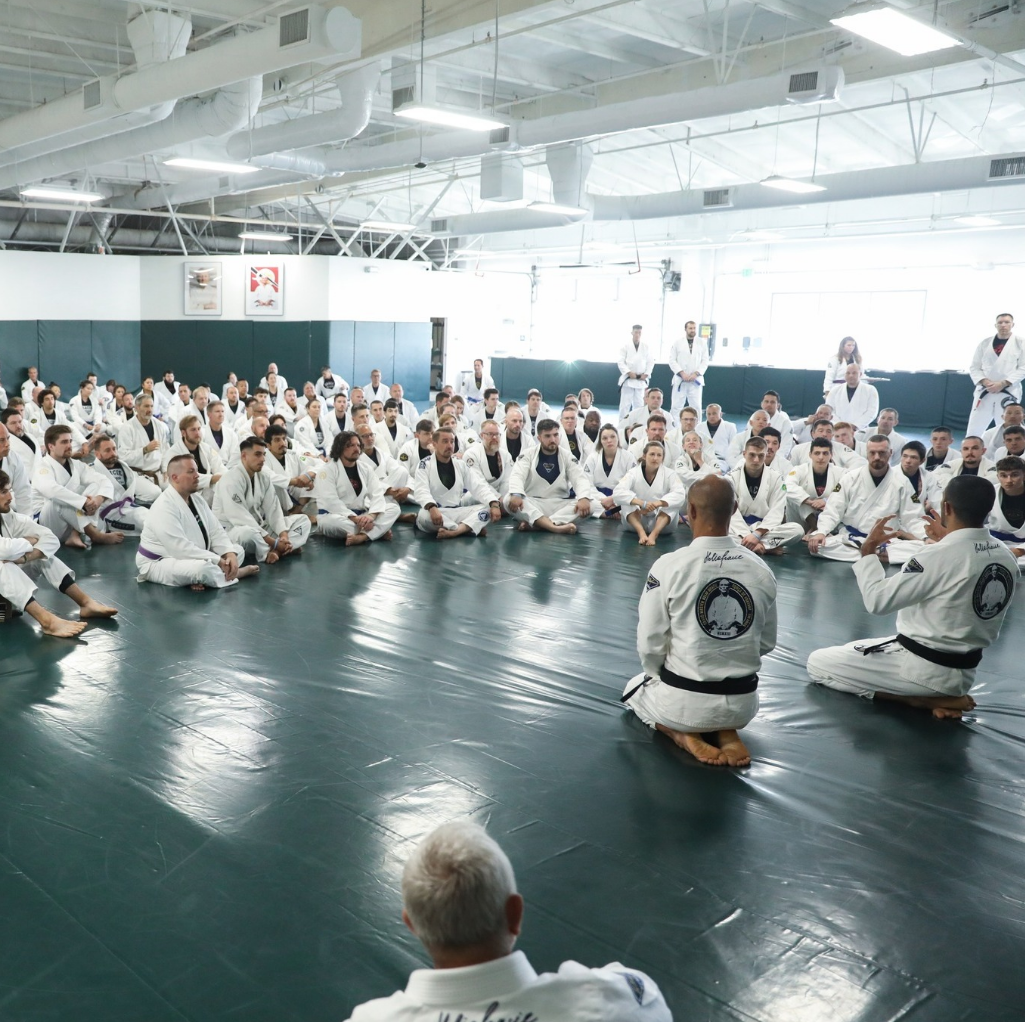
Your first class is focused on fundamentals. We explain the position, the goal, and the key details that make it work. You will drill with a partner, and you will get coaching in real time. If there is live training, we keep it controlled and appropriate for your experience level.
You do not need to be “in shape” to start. You get in shape by training. What you do need is a willingness to learn and a willingness to tap. Tapping is not losing. It is how you train tomorrow.
Jiu-Jitsu for women and beginners: skill-first, ego-last
Women’s participation in Brazilian Jiu-Jitsu has grown quickly, and the sport has responded with more female-led classes, events, and training communities. We take that seriously because the best training environment is one where you can focus on skill development, not on proving you belong.
For beginners of any background, our coaching prioritizes fundamentals, safety, and clear progress markers. We do not rush you into advanced techniques before you understand base, posture, and control. You build confidence through competence, and competence comes from doing the basics well, over and over.
If your goal includes self-defense, we keep that lens in the program as well. Even though many practitioners now train more for sport or fitness, the self-defense roots still matter. Knowing how to create space, stand up safely, and control someone who is trying to hold you down is practical, period.
Why this training fits Silicon Valley professionals
San Jose can be mentally exhausting in a way that is hard to describe until you have lived it. Jiu-Jitsu offers a different kind of focus: physical, immediate, and honest. You cannot multitask on the mat. You cannot half-listen. That is part of why it feels refreshing.
We also see a clear connection between grappling and professional performance. You learn to break large problems into small steps. You learn to test solutions and adjust quickly. You learn to stay composed when you are behind. It is not surprising that 75 percent of practitioners report improved problem-solving from consistent training. That is a huge number, and it matches what we see.
The best part is that this is not theoretical. You will feel it when you stop rushing, start framing correctly, and escape a position that used to flatten you. Those small wins add up.
Start Your Journey
Building lasting discipline takes more than a burst of motivation. It takes a place where the training is structured, the coaching is clear, and the community supports consistent effort. That is exactly what we focus on, and it is why so many adults stick with Jiu-Jitsu once they experience the learning curve in person.
If you are ready to train with purpose in San Jose, Gracie Jiu-Jitsu San Jose is here to guide you through a fundamentals-first path that builds real-world skill, better fitness, and a calmer mindset under pressure. Visit the website, check the class schedule, and take the first step when it fits your week.
Take what you learned here to the mat by joining a Jiu-Jitsu class at Gracie Jiu-Jitsu San Jose.