
When your calendar is packed, the right kind of training can give you more back than it takes.
A lot of fitness advice assumes you have unlimited time, unlimited recovery, and a workday that ends neatly at five. In San Jose, that is not most people. If your life runs on meetings, deadlines, commutes, and the constant buzz of a phone, you need training that builds energy instead of draining it.
That is where Jiu-Jitsu fits surprisingly well. In our classes, you are not just “working out.” You are practicing decisions under pressure, learning how to stay calm when you are uncomfortable, and building a kind of strength that shows up the next morning when you are back at your desk.
We work with busy professionals every week, and the pattern is consistent: the people who stick with it do not necessarily have more free time. They have a better system. Our job is to make the training structured, safe, and realistic so you can show up, learn something meaningful, and leave feeling sharper.
Why Jiu-Jitsu works for busy professionals in San Jose
Jiu-Jitsu is skill-based training, not just intensity-based training. That matters when you have limited time and you cannot afford to be sore and wrecked for two days after every session. Our approach emphasizes technique, timing, and leverage so your body and your brain both improve, even on weeks when you can only make a couple of classes.
Another reason it clicks for professionals is the built-in “reset.” When you step on the mat, your attention has to narrow. You cannot multitask through a grappling exchange. You cannot half-answer emails in your head while someone is controlling your posture. That forced focus is one of the most practical benefits for energy and mental clarity.
And finally, it is measurable. In a work environment, you are used to progress markers: projects shipped, deals closed, milestones met. Jiu-Jitsu gives you that same satisfaction. You learn a technique, you practice it with a partner, you refine it, and then it starts working more reliably. That feedback loop keeps motivation steady.
Energy and focus: what changes when you train consistently
We are careful about making big promises, but we can explain what tends to happen when your training is consistent and properly paced. First, you get better at managing stress, because you practice staying calm while your heart rate rises. That is not theoretical. It is physical, and your nervous system learns it through repetition.
Second, you improve what professionals usually call “mental endurance.” In Jiu-Jitsu, you solve problems in real time: posture, distance, grips, angles, balance. You learn to stop wasting effort. Over time, that efficiency transfers. Many students tell us they feel less scattered during the workday, like their attention has fewer leaks.
Third, your body adapts in a sustainable way. You develop core strength, hip mobility, and overall conditioning, but because technique is central, you can train hard without always going max effort. When you are balancing a career and family life, that kind of smart intensity is the difference between showing up again next week or disappearing for three months.
The moves that give you the biggest return on time
Busy professionals do best with fundamentals. Flashy techniques are fun, but a reliable base is what keeps you safe, confident, and progressing. Our beginner path is built around core movements that show up everywhere in Jiu-Jitsu and self-defense, and they are worth learning early because you will use them constantly.
Base and posture: your anti-burnout skill
“Base” is the ability to stay stable when someone tries to move you. “Posture” is how you align your spine and hips so you can breathe, move, and resist being broken down. These are not just grappling concepts. They are energy concepts. When your posture collapses, you panic-breathe and spend strength fast. When your posture is solid, you think and act.
In class, we teach you how to stack your joints, distribute weight, and stay balanced while you move. It sounds simple, but it is one of the fastest ways to feel more in control, even when you are new.
The trap and roll: a simple idea with real-world value
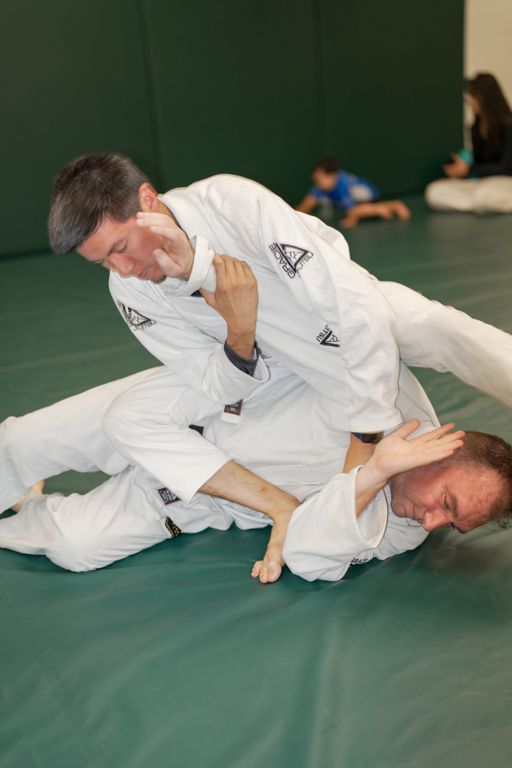
One of the first problem-solving patterns we teach is escaping from a pinned position. A common example is when someone is on top in the mounted position. The trap and roll teaches you how to secure an arm, control a leg, and reverse the position using timing and hip movement.
For professionals, this is powerful for a different reason: it trains you to stop flailing. The technique only works when you slow down enough to connect the steps. That habit, pausing and doing the next right thing, is a focus skill you can take back to work.
The guard: learning to stay effective from your back
In everyday life, being on your back is not ideal. In Jiu-Jitsu, we treat it as a position you can still work from, protect yourself from, and improve in. Guard is where many people first learn to use legs and hips as tools, not just “extra parts.”
Guard training develops coordination and core endurance without needing heavy impact. It also builds patience. You learn how to frame, control distance, and create space, which is a calm, technical way to solve pressure.
Clinch control and distance management
A lot of self-defense begins before the ground. That is why we emphasize controlling distance, recognizing grips, and moving safely in close range. For busy professionals, this kind of training is reassuring because it is practical without being reckless.
We focus on structured practice so you can learn how to stand, move, and engage with control. The better you get at managing distance, the less you rely on speed or strength.
What you learn in our adult programs in San Jose
We keep our adult curriculum structured because structure helps busy people stay consistent. You should not have to guess what to do next. Our training is designed to be progressive, with clear lessons and repeatable practice.
Gracie Combatives as a beginner-friendly start
Our foundational adult program is Gracie Combatives, built around 36 essential techniques for real-life self-defense. It is designed for beginners, including people who have never trained before and people who do not feel “athletic” yet. The point is to give you a reliable toolkit and a clean learning path.
Classes are taught with safety and clarity in mind. You will drill techniques with a partner, learn the details that make them work, and build confidence through repetition. We also provide video review materials so you can reinforce what you learned, even if your week is hectic.
Master Cycle for advanced training and live sparring
Once you have a solid base, our training progresses into a Master Cycle that includes advanced ground techniques, transitions, submissions, and live sparring. This is where your timing and decision-making sharpen fast, because sparring reveals what you truly understand.
We still keep the environment controlled. Hard training is fine. Chaotic training is not the goal. You should be able to train, improve, and go to work the next day without feeling like you got in a car accident.
A realistic weekly plan for professionals who are busy, not “lazy”
We respect time constraints. Most professionals do not need a six-day plan. They need a plan that survives business travel, family obligations, late meetings, and the occasional week that just goes sideways.
Here is a simple approach we recommend, and we see it work well:
1. Start with two classes per week so your body adapts without excessive soreness.
2. Pick consistent days, like Tuesday and Thursday, so training becomes automatic.
3. Add a third class only when recovery feels stable and sleep is decent.
4. Use video review on off days for ten minutes to keep techniques fresh.
5. If you miss a week, return without trying to “make up” volume all at once.
This is how Adult Jiu-Jitsu San Jose, CA training becomes sustainable. The goal is not to win the week. The goal is to train for months, then years, without burning out.
What a class feels like, especially when you are new
Walking into your first Jiu-Jitsu class can feel strange, mostly because it is unfamiliar. There are terms you do not know yet. There is physical contact. There is also a learning curve. But the atmosphere matters, and we take that seriously.
We run classes with clear instruction, partner drilling, and a pace that lets you learn without getting overwhelmed. You will sweat, but you will also think. Many new students are surprised by how “technical” it feels, like learning a new language with your body.
And yes, you will make mistakes. That is expected. We would rather you move carefully and ask questions than try to muscle through. Over time, the mat becomes a place where you can work hard without carrying the mental load of the day.
Staying safe so your training supports your career
For busy professionals, injuries are not just painful. They are disruptive. We build our training around longevity, which means we emphasize tapping early, learning control, and progressing at a smart pace.
A few practical habits make a big difference:
• Warm up with intention, especially hips, neck, and shoulders
• Choose control over intensity while you are still learning positions
• Tap early to joint locks and chokes, and treat tapping as good communication
• Ask questions when something feels confusing instead of forcing it
• Prioritize sleep and hydration on training days, because recovery is part of progress
When Jiu-Jitsu is trained with structure and respect, it becomes a long-term practice, not a short burst followed by months off.
Why this training helps beyond the mat
We often hear professionals describe the same “spillover benefits.” Meetings feel less stressful. Conflict feels easier to manage. Energy feels steadier. The body feels more capable. Part of that is the conditioning, but a bigger part is the mindset you build.
Jiu-Jitsu teaches you to be comfortable being uncomfortable, without spiraling. You learn to breathe under pressure, problem-solve with limited options, and stay patient when progress is slow. Those are career skills, honestly, just taught in a much more physical way.
If you are searching for Jiu-Jitsu San Jose, CA options because you want self-defense, that is valid. If you are searching because you want energy and focus, that is also valid. The training meets you where you are, as long as you show up consistently.
Ready to Begin
If you want training that respects your schedule and still challenges you, we built our programs to make that possible, right here in San Jose. At Gracie Jiu-Jitsu San Jose, we focus on structured learning, practical self-defense, and a pace that helps you improve without feeling wrecked for work the next day.
You do not need a perfect week to start, just a realistic one. When you begin with fundamentals, keep attendance steady, and train with control, Jiu-Jitsu becomes a tool for better energy, sharper focus, and more confidence in everyday life.
Train with experienced instructors and a supportive team by joining a Jiu-Jitsu class at Gracie Jiu-Jitsu San Jose.