
Jiu-Jitsu gives you a fast path to real control, so you can stay safe without relying on punching power.
In San Jose, most adults looking for self-defense are not searching for a sport highlight reel. You want something practical, something you can learn quickly, and something that still works when an opponent is bigger, stronger, and loud. That is exactly why we teach Jiu-Jitsu: it is built around leverage, control, and decision-making under pressure, not brute force.
Brazilian Jiu-Jitsu is widely recognized as one of the most effective martial arts for rapid self-defense in 2024 because it lets smaller people neutralize larger threats through positioning and technique. And in real life, many confrontations end up on the ground, even when nobody planned it. Our job is to make sure you are not surprised by that moment.
What makes this training feel different, especially for busy adults, is how quickly you gain usable skills. You learn how to protect yourself without escalating with strikes, how to stabilize a chaotic situation, and how to get away when you need to. Confidence comes from options, and Jiu-Jitsu gives you options.
Why control-based self-defense matters in San Jose
San Jose is a place where people move fast: commuting, working late, parking garages, stairwells, crowded sidewalks, and plenty of moments where you would rather avoid trouble than win a fight. That is the point. We focus on skills that help you control distance, manage contact safely, and de-escalate whenever possible.
Control-based training is also a major trend across modern defensive tactics because it reduces unnecessary damage. In law enforcement, BJJ-inspired approaches have been linked to a 37% reduction in use-of-force incidents and a 44% reduction in injuries to arrest subjects. We bring that same principle into civilian self-defense: learn to restrain, create space, and disengage, rather than trading blows.
Another benefit people do not expect: as you train consistently, you often feel calmer. Research reviews have noted multiple studies where practitioners reduced aggression over time. That lines up with what we see daily. You get more capable, and you also get more composed.
What makes Jiu-Jitsu effective for rapid self-defense
Jiu-Jitsu works because it solves a common problem: what happens when someone gets hands on you. Striking arts can be useful, but punching well under stress is hard, and punching can create legal and medical consequences fast. Grappling gives you a way to control an aggressor without turning the situation into a head-to-head damage contest.
Technique over power, especially for adults
Our Adult Jiu-Jitsu San Jose, CA students come in with all kinds of backgrounds: former athletes, office workers, parents, people who have never trained anything. The common thread is that nobody wants to rely on being the strongest person in the room. We teach you to build frames, angles, and leverage so your body weight and structure do the heavy lifting.
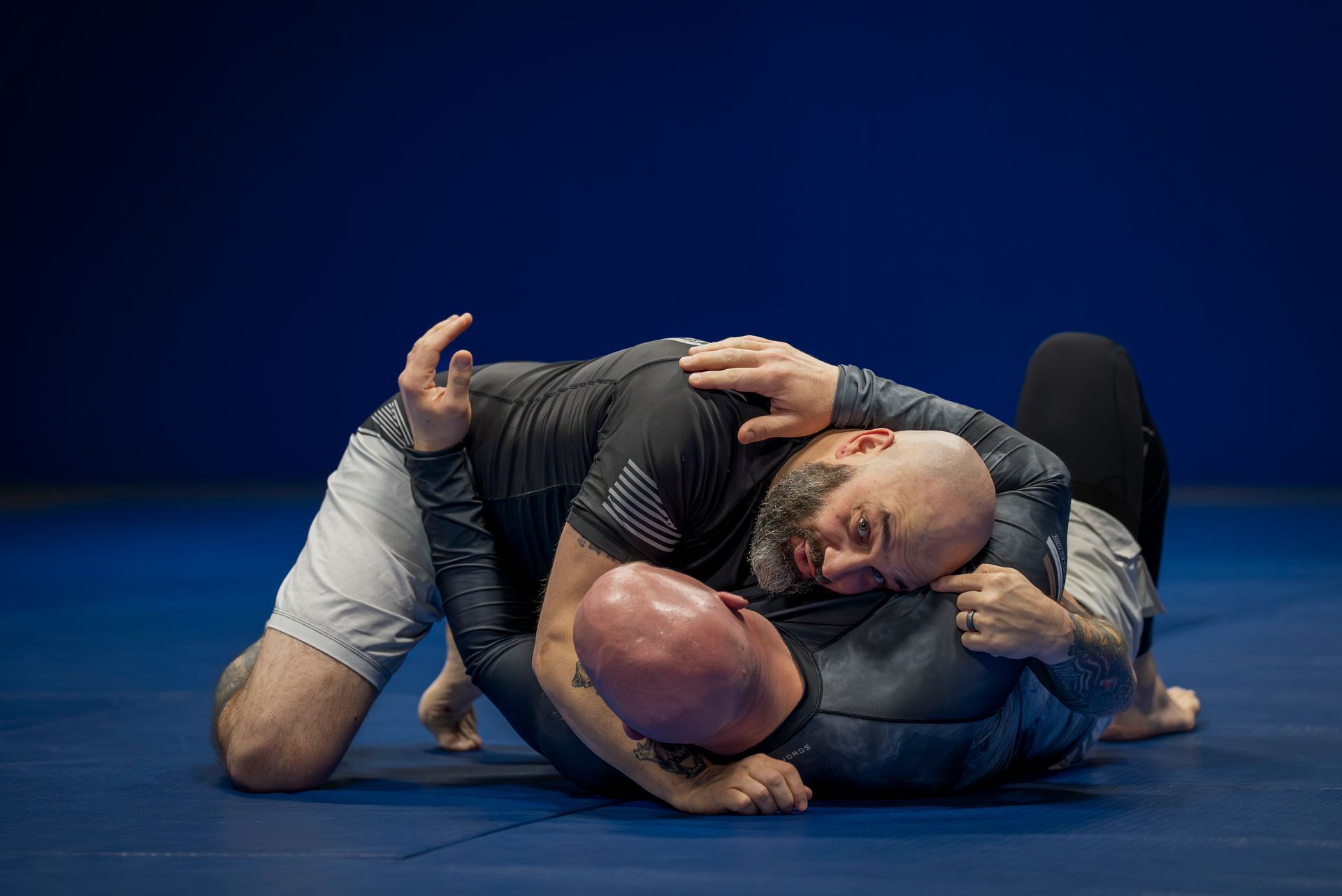
That is not just a slogan. A well-built guard position can stop punches. A properly timed sweep can put you on top without needing to “out-muscle” anyone. A stable top control can keep you safe while you decide what to do next.
Ground control is not optional in real encounters
A lot of real confrontations end up with someone slipping, getting shoved, tripping over a curb, or getting tackled. The ground is messy. It steals your balance and changes your options. Jiu-Jitsu San Jose, CA training prepares you to keep breathing, keep your posture, and work from positions where you can protect your head and manage an attacker’s weight.
We do not treat the ground like a worst-case scenario. We treat it like a likely scenario, which is honestly more comforting. When you know what to do there, panic drops.
Rapid-response tactics we teach for real-world safety
We teach a full curriculum, but a few core tactics show up again and again because they are high-percentage and easy to pressure-test safely.
Closed Guard: protect yourself, slow the chaos
Closed Guard is one of the most important self-defense positions for beginners because it gives you immediate defensive structure when an attacker is on top. If you end up on your back, you learn how to close distance, control posture, and reduce the opponent’s ability to strike effectively.
In our classes, we focus on details that matter outside the gym: keeping your head safe, managing wrist control, and using your legs to break posture. Closed Guard is not “lying there.” It is active control that buys you time to think and act.
Scissor Sweep: reverse position and create space
A sweep is a game-changer in a self-defense context because it flips who is controlling whom. The Scissor Sweep is a classic example: you off-balance the person inside your guard and turn the situation into top position where you can stabilize, stand up, or disengage.
We coach this as a timing skill, not a strength move. You learn to pull, angle, and cut with your legs in a way that topples someone who is pressuring forward. When it clicks, it feels almost unfair, in a good way.
Knee on Belly: control without getting stuck
Knee on Belly is one of our favorite “control and go” positions. You are on top, you can apply pressure, you can see what is happening around you, and you can choose to disengage quickly. In self-defense, that matters because staying tied up on the ground can be risky if the environment changes.
We teach you how to keep your base, how to shift your weight, and how to move from Knee on Belly to standing safely. It is a position that helps you control without overcommitting.
No-Gi practicality: skills that do not depend on clothing
A lot of modern self-defense training favors No-Gi concepts because you cannot assume jackets, lapels, or sturdy grips. We include No-Gi style controls like clinch entries, front headlock positions, and practical chokes that rely on body mechanics instead of fabric.
This does not mean we ignore structured training. It means we make sure your skills translate. When you understand head position, hip position, and pressure, you can adapt to what you are wearing, what someone else is wearing, and what space you are in.
How we build confidence without feeding aggression
Confidence in self-defense is not about feeling invincible. It is about feeling prepared. We want you to leave training with a clearer sense of what you can do, what you should avoid, and how to keep yourself safe with the least amount of force needed.
We also coach decision-making. That includes boundary setting, awareness, and simple habits that reduce risk. And it includes the humility to recognize that the safest win is often leaving early.
Here is a practical mindset we reinforce in training:
- Control first: stabilize the position, protect your head, slow the pace
- Communicate when possible: de-escalation and clear commands can matter
- Escape when available: standing up safely is often the best outcome
- Use force proportionally: the goal is safety, not punishment
- Seek help immediately: once you disengage, create distance and get support
That framework keeps you grounded. You learn skills, but you also learn restraint, which is a real form of strength.
A realistic answer about multiple attackers
People ask this in San Jose all the time: what is the best defense against multiple attackers. Our answer is direct. If you can run, run. Jiu-Jitsu is strongest in one-on-one situations where you can establish control. With multiple people, the priority is movement, exits, and not getting tied up.
That said, training still helps. You learn how to stand up from the ground under pressure, how to frame and create space, and how to avoid getting pinned. Those are valuable even when your goal is simply to escape.
What your first weeks of Adult Jiu-Jitsu can look like
Starting something new can feel intimidating, especially a contact skill. We keep the process structured so you can relax and focus on learning. You will work with partners, but we set expectations around safety, tapping early, and keeping intensity appropriate.
A simple progression we often see looks like this:
1. Week 1: learn basic positions, how to tap, how to protect your head and posture
2. Weeks 2 to 4: start linking escapes and control positions, build comfort in movement
3. Month 2: add sweeps and top control concepts, begin light positional sparring
4. Month 3 and beyond: pressure-test more often, refine timing, build calm under stress
The biggest surprise for many adults is how technical it is. You are not just “going hard.” You are solving problems with your body, which is oddly satisfying after a long day at work.
Conditioning that supports your Jiu-Jitsu progress
You do not need to be in perfect shape to begin. Training improves your fitness as you go. Still, a little preparation helps, especially for adults managing schedules and recovery.
We generally recommend focusing on:
- Foundational strength: squats and deadlifts build durable hips and legs for grappling
- Cardio base: cycling, steady jogging, or brisk incline walks support longer rounds
- Short bursts: HIIT-style intervals mimic the start-stop rhythm of live training
- Mobility and stability: yoga or Pilates-style work helps hips, spine, and shoulders
- Sleep and hydration: boring, yes, but it changes everything
Think of conditioning as support, not homework. Your main progress comes from showing up and training consistently.
Safety and training culture: how we keep it sustainable
Self-defense training only works if you can keep training. We take safety seriously because injuries derail progress and confidence. In class, we emphasize controlled drilling, clear communication with partners, and smart intensity choices.
We also coach you to recognize the difference between discomfort and danger. Grappling can be tiring and awkward at first. That is normal. But joint pain, sharp pressure, or panic signals are worth addressing immediately. Tapping is a skill, and we treat it like one.
Over time, you build a kind of everyday toughness: not reckless toughness, but steady resilience. You learn you can problem-solve under pressure, which tends to show up in the rest of life too.
Take the Next Step
If you want self-defense that works quickly, we will point you toward the tactics that matter most: posture, base, escapes, and control positions you can actually use. That is the core of what we teach, and it is why Jiu-Jitsu remains such a reliable approach for adults who want practical skills without relying on strikes.
You can experience this approach firsthand at Gracie Jiu-Jitsu San Jose, where our training is built to help you develop real capability and real confidence in a supportive, structured environment. When you are ready, we will help you start at a pace that feels challenging but sustainable.
Train with experienced instructors and a supportive team by joining a Jiu-Jitsu class at Gracie Jiu-Jitsu San Jose.